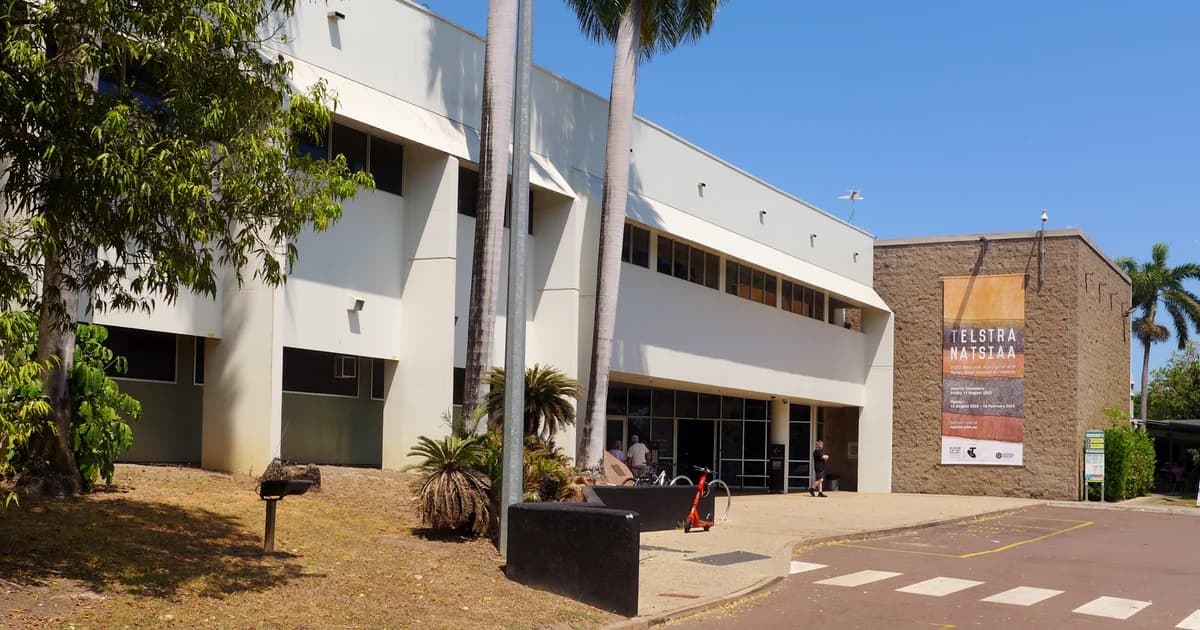

Stays near Museum and Art Gallery of the Northern Territory
Find Nearby Accommodation
Hotels, apartments, hostels and luxury stays
We may earn a commission from bookings made through these links, at no extra cost to you.
Tours and Experiences
Tours & Experiences

Private Full Day Darwin City Tour with Lunch and Pickup
5.0(3)

Darwin Private City Tour
5.0(1)

Darwin City Tour + Crocodile Cruise
4.9(7)

Darwin City Sights and Jumping Crocodile Cruise
4.8(10)

Cape Adieu Darwin Sunset Dinner Cruise
4.8(750)

Darwin City Explorer Tour
4.5(91)
Powered by Viator · Affiliate link
The Museum and Art Gallery of the Northern Territory sits on Conacher Street in Darwin, offering one of the most comprehensive introductions to the Top End's natural world, cultural history, and artistic heritage — all at no cost to visitors. Whether you're a first-time visitor to Darwin or a returning traveller keen to deepen your understanding of the region, MAGNT provides genuine context for the landscapes, peoples, and wildlife you'll encounter across the Northern Territory.
The museum is operated as a major regional institution and holds collections that span Aboriginal and Torres Strait Islander art, natural history specimens, and tropical heritage exhibits. Few places in Australia bring together such a breadth of material under one roof, and the free entry policy means there's little reason not to include it in your Darwin itinerary.
What to See and Do
The collections at MAGNT are wide-ranging. The Aboriginal and Torres Strait Islander art holdings are among the most significant in the country, offering an opportunity to engage with works and cultural objects from communities across the Northern Territory and beyond. These collections are presented with cultural context rather than purely as aesthetic displays, making them informative as well as visually engaging.
The natural history component of the museum reflects the remarkable biodiversity of the Top End — a region with distinct wet and dry seasons, a complex coastline, and ecosystems found nowhere else in Australia. Expect specimens and exhibits that speak to the region's tropical environment, its marine life, and its geological story.
Tropical heritage exhibits round out the collection, giving visitors a sense of Darwin's layered human history — a city shaped by colonial settlement, wartime bombardment, and cyclone devastation, as well as the deep and continuing presence of Aboriginal cultures.
The museum also runs changing exhibitions, so it's worth checking their website at magnt.net.au before your visit to see what's currently on.
History
MAGNT was established to document, preserve, and present the Northern Territory's natural and cultural heritage — a task that carries particular weight in a part of Australia where Indigenous history extends back tens of thousands of years and where the natural environment is extraordinary in its diversity.
Over time, it has grown into one of Australia's major regional museums, serving both locals and visitors as a key cultural institution. Its collections continue to expand, and it plays an active role in research and community engagement across the Territory.
Getting There and Access
The museum is located on Conacher Street, within walking distance of Darwin's CBD. If you're staying in the city centre, you can reach it on foot without much difficulty.
By car, follow signs from the Stuart Highway into the city. On-street parking is available around Conacher Street, with some paid car parks nearby. Accessible parking is also available. Be aware that parking can be tight during the peak tourist season — the dry season months bring significant visitor numbers to Darwin — so arriving early will improve your chances of finding a spot close by.
Local bus services run to the area if you prefer public transport.
Several Darwin city tour operators include MAGNT as part of broader sightseeing itineraries. If you're interested in seeing multiple Darwin landmarks in a single day, a guided city tour can be a practical way to structure your time.
Visitor Tips
- Allow 1.5 to 2 hours for a relaxed browse through the main collections, though you could easily spend longer if a particular exhibition catches your interest
- Arrive early in the morning or later in the afternoon to avoid school groups, which tend to move through during mid-morning
- The café on-site means you can break up your visit without heading elsewhere. If you'd prefer to bring your own food, you can picnic outside
- Lockers are available, which is handy if you're carrying bags from elsewhere in the city
- The museum is pram friendly, making it a practical choice for families with young children
- Free entry means you can treat it as a cultural stop of any length — pop in for an hour between other plans, or settle in for the afternoon
- Check the website before visiting to confirm current exhibitions and any special events that may affect access or crowd levels
Best Time to Visit
Darwin's climate divides neatly into wet and dry seasons, and that distinction shapes when visiting MAGNT is most pleasant. The dry season — roughly May through September — brings cooler temperatures and lower humidity, making it far more comfortable to move around the city. This is also Darwin's peak tourist season, so while the weather is ideal, the museum will be busier.
If you're visiting during the dry season, Tuesday to Thursday mornings tend to be the quietest times in the galleries. Weekends and school holiday periods attract larger crowds.
The wet season, from October through April, brings heat, humidity, and the possibility of significant rainfall. The museum's fully indoor setting makes it a genuinely useful retreat on a heavy wet season day, and you're likely to find the galleries quieter during this period.
The museum opens daily from 10:00 to 16:00.
Nearby Attractions
Darwin has a concentrated cluster of attractions around the waterfront and inner city areas. Many visitors combine a museum visit with other Darwin landmarks — the city's foreshore, the Botanic Gardens, and various historical sites connected to the Second World War bombing of Darwin are all accessible from the city centre. Several tour operators run combined city sightseeing experiences that take in multiple locations, and some also pair a Darwin city tour with a jumping crocodile cruise on the Adelaide River — a popular combination for those wanting to cover a lot of ground in a single day.
Video
Getting There
Location and map
Located in Darwin city centre on Conacher Street. Accessible by car from Stuart Highway; follow signs to the city. Public transport: local bus services serve the area. Walking distance from Darwin CBD.
Parking
On-street parking and nearby car parks available around Conacher Street. Some free parking; some paid options nearby. Accessible parking available. Can be limited during peak season — plan accordingly.
Visitor Tips
- •Visit early morning or late afternoon to avoid school groups
- •Allow 1.5–2 hours for a relaxed browse
- •Free entry makes it ideal for a quick cultural stop while touring
- •Check their website for current exhibitions and special events
- •Parking can be tight during peak tourist season — arrive early
Find Nearby Accommodation
Hotels, apartments, hostels and luxury stays
We may earn a commission from bookings made through these links, at no extra cost to you.
Quick Facts
At a Glance
The Place
- Significance
- Local
Plan Your Visit
- Entry
- Free
- Duration
- 1-2 hours
- Best Time
- May to September (dry season) — cooler weather and fewer school holidays mean quieter galleries. Visit Tuesday to Thursday mornings for the least crowds. Open daily 10:00–16:00.
- Hours
- Mo-Su 10:00-16:00
Location
- Area
- The Gardens
- Region
- Darwin
- State
- Northern Territory
Good to Know
Highlights
Activities
Family & Visitor Info
- Ages
- All ages
- Shade/Cover
- Indoor
- Pram Friendly
- Yes
- Lockers
- Available
Food & Drink
Café on-site; bring your own food for picnic outside if preferred
Features
Travellers also visited
Tap + to build a trip
Find Nearby Accommodation
Hotels, apartments, hostels and luxury stays
We may earn a commission from bookings made through these links, at no extra cost to you.
Nearby
Campsites(5)
Trails(3)
Attractions(3)
Toilets(3)
Groceries(5)
Fuel(5)
United Parap
United Petroleum · 1.7km
Updated 9h ago
United Darwin, Smith St
United Petroleum · 2.4km
Updated 9h ago
Independent Baileys Darwin
Ampol Independent · 3km
Liberty Katherine
Liberty Oil · 3.2km
United Ludmilla
United Petroleum · 3.9km
Updated 9h ago
Dump Points(1)
Darwin Greyhound Club Dump Point
Free · 6.7km