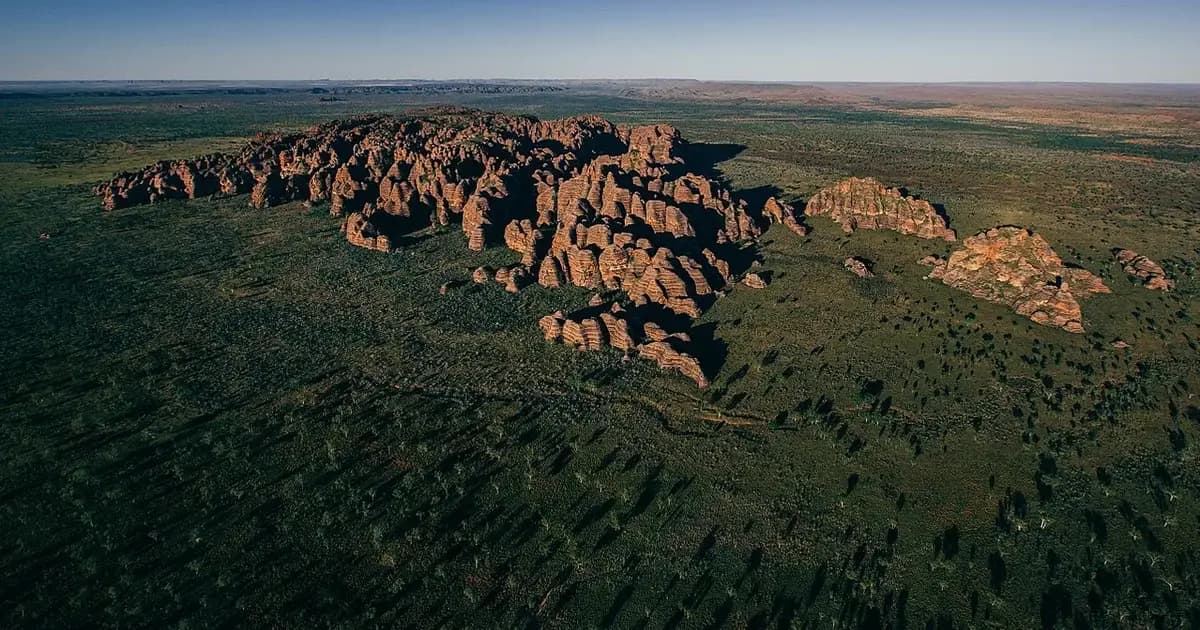
Bungle Bungles (Purnululu National Park)
Bungle Bungles (Purnululu National Park) — The Bungle Bungles are a series of spectacular beehive-shaped sandstone towers striped in alternating bands of orange silica and dark…
National Park in Western Australia

Find Nearby Accommodation
Hotels, apartments, hostels and luxury stays
We may earn a commission from bookings made through these links, at no extra cost to you.
World Heritage Status of Bungle Bungles (Purnululu National Park)
- Status
- UNESCO World Heritage Site
About Bungle Bungles (Purnululu National Park)
The Bungle Bungles are a series of spectacular beehive-shaped sandstone towers striped in alternating bands of orange silica and dark grey-green lichen within [Purnululu National Park](/au/national-parks/wa/purnululu-national-park) in the eastern Kimberley. The range covers 450 km² and was largely unknown to the outside world until the 1980s. Listed as a UNESCO World Heritage Site in 2003, Purnululu is one of the most visually extraordinary landscapes on Earth.
Tours & Experiences

Powered by Viator · Affiliate link
The Bungle Bungles rise from the red earth of the eastern Kimberley like something conjured from another world — thousands of beehive-shaped sandstone towers, each banded in alternating stripes of orange silica and dark grey-green lichen, stacked across a 450-square-kilometre landscape that remained virtually unknown to the wider world until the 1980s. Located within Purnululu National Park, this UNESCO World Heritage-listed site is one of Australia's most extraordinary geological environments, and one that rewards travellers willing to make the effort to get there.
The scale of the place takes time to absorb. What looks from a distance like an undulating mass of rounded domes reveals itself, on closer inspection, to be a deeply intricate system of gorges, chasms, and narrow slots carved through ancient sandstone over an estimated 350 million years. The distinctive banding — orange where silica has cemented the rock, darker where cyanobacteria and lichen colonise the surface — gives the domes their unmistakable striped appearance and makes Purnululu visually unlike anywhere else on the continent.
History
Long before the Bungle Bungles entered the Australian public consciousness, the landscape held deep significance for the Kitja and Kija peoples, whose connection to this country extends back thousands of years. For much of the twentieth century, the range remained isolated from broader awareness — accessed only by those with local knowledge, working in the pastoral industry, or travelling through the remote Kimberley on foot or horseback.
Aerial surveys in the 1980s brought the formations to wider attention, and the response was immediate. Purnululu National Park was declared in 1987, formally recognising the significance of the landscape and beginning the process of managing access and conservation. In 2003, UNESCO listed Purnululu as a World Heritage Site, acknowledging not only the outstanding geological and geomorphological values of the Bungle Bungle Range, but also its cultural importance to Aboriginal Australians.
Today the park is jointly managed by the Western Australian Department of Biodiversity, Conservation and Attractions alongside Aboriginal traditional owners — an arrangement that reflects the ongoing and living relationship between the Kitja and Kija peoples and the country that Purnululu represents.
What to See and Do
Echidna Chasm
Of all the walks within Purnululu, Echidna Chasm is arguably the most striking. The track leads into a narrow slot gorge cut deep into the Bungle Bungle Range, where the walls rise to heights that reduce the sky above to a thin ribbon of light. The gorge is relatively short and the walk is not particularly strenuous, but the atmosphere it creates — cool, shadowed, and hemmed in by rock faces glowing orange and ochre — is unlike anything you'll encounter on a standard bushwalk.
Timing matters here. Echidna Chasm is at its most dramatic at midday, when direct sunlight penetrates the slot and illuminates the canyon walls from above. Visiting outside this window means missing the full effect, so it's worth planning your day around an arrival close to noon if conditions allow.
Cathedral Gorge
On the southern side of the park, Cathedral Gorge offers a very different experience. The walk follows a dry creek bed through a gradually widening valley before opening into a vast natural amphitheatre — a circular chamber with a shallow pool at its base and walls that soar overhead. The acoustics of the space are remarkable, and the sense of enclosure combined with the sheer scale of the surrounding rock is something photographs don't quite capture.
Cathedral Gorge is accessible to most reasonably fit walkers and is one of the more popular walks in the park. It's best visited in the cooler parts of the day given the exposed sections of the approach track.
Helicopter Flights
For those who want to understand the Bungle Bungles in full, a helicopter flight over the range is genuinely useful rather than simply a luxury add-on. The formations are so vast and so densely packed that ground-level access gives you only a partial picture — from the air, the full extent of the beehive domes, the river systems cutting through the range, and the broader context of the Kimberley landscape become visible all at once. Helicopter flights operate from within the park, and several tour operators also run scenic flights departing from Kununurra and Halls Creek. A Bungle Bungle Scenic Flight is one of the standout ways to experience the region.
Birdwatching
Purnululu supports more than 130 bird species, making it a significant destination for birdwatchers. The combination of gorge systems, open spinifex country, and seasonal waterways creates a range of habitats that attract both resident and migratory species. Early mornings in and around the gorges tend to be the most productive times for bird activity.
Photography
The Bungle Bungles present serious photographic challenges and rewards in equal measure. The light changes dramatically through the day, and the contrast between the warm orange tones of the domes and the deep shadows of the gorges requires careful exposure management. Sunrise and sunset bring the outer domes to life with colour, while midday is the window for shooting inside Echidna Chasm. Wide-angle lenses are useful in the gorges; a longer focal length helps isolate individual dome formations from distance.
Getting There and Access
Getting to Purnululu is a significant undertaking, and that's part of what defines the experience. The park sits approximately 250 kilometres southwest of Kununurra via the Great Northern Highway. From the highway turn-off, a 53-kilometre unsealed track leads to the visitor centre — and this stretch is where many travellers underestimate the commitment involved.
A 4WD vehicle is mandatory. This is not a precautionary recommendation — the track includes creek crossings and rough corrugated sections that make it genuinely impassable for conventional low-clearance vehicles. Attempting the road in a 2WD risks becoming stranded in a remote area with limited assistance and extreme temperatures. If you don't have access to a 4WD, the only practical alternatives are scenic or helicopter flights from Kununurra or Halls Creek, which offer access to the landscape without requiring ground-level entry.
Allow roughly 2.5 to 3 hours for the drive in from the highway, depending on road conditions and your vehicle. Road conditions can vary across the season, so it's worth checking with the visitor centre or the Department of Biodiversity, Conservation and Attractions before departure.
There is no fuel available within the park. Fill your tank completely before leaving Kununurra or Halls Creek — do not assume you can manage on a partial tank given the distances and conditions involved.
For travellers without a 4WD, or those who want to combine ground and aerial access, tour operators run guided experiences into the park from Kununurra, including the Domes & Cathedral Gorge Walk, which allows visitors to experience the key sites with logistical support provided.
Facilities
The Purnululu Visitor Centre is located near the park entrance and provides orientation information, maps, and displays about the park's geology and cultural significance. It's worth stopping here before heading further into the park to understand the layout and current conditions.
Two campgrounds serve visitors within the park — Walardi and Kurrajong — both equipped with toilet facilities. Campsite numbers are limited and demand during peak season is high, so booking well in advance is strongly advised. Turning up without a reservation during the busy months of June through August is a significant risk.
For those who prefer not to camp, safari tent accommodation is available within the park, offering a more comfortable base without requiring your own camping equipment. A kiosk operates during the open season, but food supplies and options are limited — bringing sufficient provisions from Kununurra or Halls Creek is sensible.
Best Time to Visit
Purnululu National Park operates on a strict seasonal basis. The park opens in April and closes at the end of November, with the wet season (December through March) making access impossible — the unsealed access road becomes impassable and conditions across the park are dangerous. If you're planning a visit, this window is firm.
Within the open season, the cooler months of June, July, and August represent peak visitation. Temperatures are manageable during the day and pleasant in the evenings, making extended walking comfortable. The trade-off is that campgrounds fill quickly and the main gorge walks can be busy at popular times of day.
The shoulder periods of April–May and October–November offer a quieter experience with fewer visitors, though temperatures in April–May can still be warm, and October–November brings increasing heat as the wet season approaches. Walking early in the morning and resting during the middle of the day is advisable throughout the season.
Regardless of when you visit within the open months, carrying more water than you think you'll need is essential. The Kimberley heat can be extreme, shade is limited on many of the approach tracks, and dehydration is a genuine risk rather than a theoretical one.
Visitor Tips
- Plan for a minimum of two days, ideally more. The main gorge walks are on opposite sides of the range, requiring separate drives, and rushing the park does it a disservice. Two days is a practical minimum; four days allows you to walk at a comfortable pace and spend time simply taking in the landscape between the main sites.
- Book your campsite before you leave for the park. Availability during peak season is limited, and there are no alternatives nearby if you're turned away.
- Time Echidna Chasm for midday. The light inside the gorge changes significantly through the day, and the midday window — when sunlight enters the slot directly — is when the walls are most vividly illuminated.
- Carry excess water and a full tank of fuel. These are not optional precautions. The nearest fuel is in Kununurra or Halls Creek, and the nearest medical assistance is a long way from the park's interior.
- Check road conditions before departing. Even within the open season, sections of the access road can be affected by localised weather. The park's managing authority can provide current information.
- Helicopter flights can be booked from within the park for those who want an aerial perspective after arriving by road — this is one of the most effective ways to understand the full scale of the range.
Nearby Attractions
Travellers using Kununurra as a base for Purnululu have access to one of the Kimberley's most well-serviced regional centres, with accommodation, supplies, and tour operators catering to visitors heading into the park. Kununurra is also a gateway to Lake Argyle — one of Australia's largest reservoirs — and the broader Ord River Irrigation Area, which offers its own distinctive landscape of red rock escarpments and wetland habitats.
Halls Creek, to the south, provides an alternative base for those approaching from the southern end of the Great Northern Highway and has its own connections to Kimberley history and the surrounding landscape.
Warnings
Getting There
250 km southwest of Kununurra via Great Northern Highway; 53 km unsealed 4WD track from highway to visitor centre. Also accessible by scenic flight from Kununurra or Halls Creek.
Nearest airport
Visitor Tips
- •A 4WD is mandatory — do not attempt in a 2WD
- •Helicopter flights give the best views of the full range
- •Echidna Chasm is most dramatic at midday when sun enters the slot
- •Book campsites in advance — they fill quickly during peak season
Tours & Experiences
Powered by Viator · Affiliate link
Find Nearby Accommodation
Hotels, apartments, hostels and luxury stays
We may earn a commission from bookings made through these links, at no extra cost to you.
Quick Facts
At a Glance
The Place
- UNESCO
- World Heritage Site
- Significance
- World Heritage
Plan Your Visit
- Entry
- Paid
- Duration
- 2–4 days
- Best Time
- April to November (park closed December to March in wet season)
- Hours
- Open April to November only (closed wet season). Entry by 4WD or scenic flight.
Location
- Region
- Kimberley
- State
- Western Australia
Highlights
Activities
Features
Facilities
Travellers also visited
Tap + to build a trip
Find Nearby Accommodation
Hotels, apartments, hostels and luxury stays
We may earn a commission from bookings made through these links, at no extra cost to you.