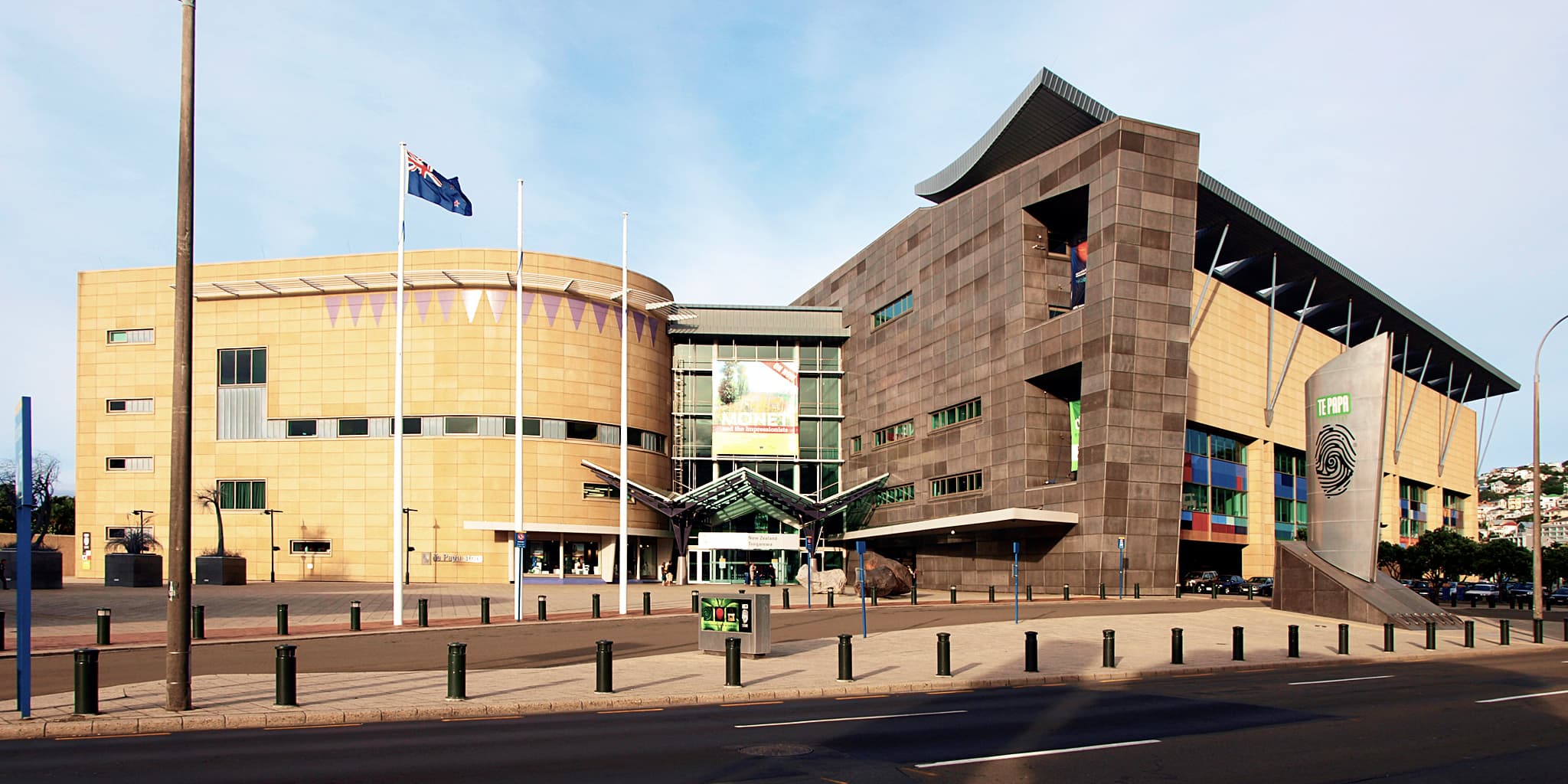
Te Papa Tongarewa — Museum of New Zealand
Te Papa Tongarewa
Te Papa Tongarewa — Museum of New Zealand — Museum in Wellington City, wellington.
Museum in Wellington
Photo: Wikimedia Commons (CC BY-SA)
 Written by Mia & Tom Hartley· Updated Apr 2026
Find Nearby Accommodation
Hotels, apartments, hostels and luxury stays
We may earn a commission from bookings made through these links, at no extra cost to you.
About Te Papa Tongarewa — Museum of New Zealand
New Zealand's national museum on Wellington's waterfront. Te Papa (meaning 'Our Place') is an innovative, interactive museum telling the story of New Zealand through Maori taonga (treasures), natural history, art, and the national experience. Home to the world's largest colossal squid specimen, the earthquake simulator, and significant Maori and Pacific collections.
New Zealand's national museum sits right on Wellington's waterfront, making it one of the more accessible cultural institutions in the country. Te Papa Tongarewa — the name translates roughly as "Our Place" — opened in February 1998, replacing the older National Museum, and has since become a significant destination for anyone wanting to understand New Zealand's natural history, indigenous culture, and national identity. Entry is free, and the museum is open daily from 10am to 6pm.
The building itself is on Cable Street in Wellington's city centre, positioned directly on reclaimed waterfront land. Its scale can be deceptive from the outside — plan for at least three to four hours inside, and be aware that most visitors who budget two hours find themselves running short.
What to See and Do
Te Papa spans multiple levels and covers an enormous range of subjects. The highlights that tend to draw the largest crowds are the colossal squid specimen and the earthquake house, both of which are popular enough to have queues during busy periods.
The colossal squid — Mesonychoteuthis hamiltoni — was acquired by the museum in 2007 and is the largest known specimen of its species in the world. It's displayed in a temperature-controlled case and gives a genuine sense of the scale of deep-sea life that rarely surfaces.
The earthquake house is an interactive simulator that replicates the experience of being in a New Zealand earthquake. It's a logical inclusion for a country as seismically active as New Zealand, and it tends to be one of the more memorable experiences in the museum — though wait times can build quickly on busy days. Check at the information desk when you arrive.
The Gallipoli exhibition is another major draw, focusing on the First World War campaign through the stories of eight New Zealanders who served there. The exhibition uses large-scale figures produced in collaboration with Weta Workshop, and the level of detail is considerable.
Te Papa's Maori and Pacific collections are central to its identity as a bicultural institution. The museum was established explicitly to honour both Maori and Pakeha (European) heritage, and the taonga (treasures) on display include objects actively managed in partnership with iwi (Maori tribes). The whare whakairo (carved meeting house) is among the significant pieces you'll encounter in these collections.
Beyond the headline exhibits, Te Papa also holds substantial natural history and art collections, and hosts regular touring exhibitions — worth checking the website before your visit to see what's currently showing.
History
Te Papa Tongarewa was established as a bicultural national institution, a deliberate departure from the older National Museum it replaced. It opened in February 1998 on Wellington's reclaimed waterfront, with the design and concept intended to reflect both Maori and European aspects of New Zealand's heritage rather than prioritising one over the other.
The museum's approach to its Maori collections is ongoing and collaborative — iwi retain a degree of guardianship over taonga held at Te Papa, which distinguishes it from many comparable institutions internationally.
Getting There and Access
Te Papa is straightforward to reach from anywhere in Wellington's city centre. It's walking distance from Te Aro and Lambton Quay, and accessible via bus, train, or cable car (a Snapper card is required for Wellington's free public transport). The museum is also reachable from State Highway 1.
If you're driving, paid parking is available in the adjacent waterfront car park, which has more than 1,000 spaces. Accessible parking and a drop-off point are available at the museum entrance. Street parking nearby is limited, and public transport is generally the easier option, particularly on weekends.
The building is fully wheelchair accessible, pram-friendly, and has lockers available if you need to store bags. Guided tours and guided walks are also available for those who want more context than self-directed exploration provides.
Visitor Tips
- The earthquake simulator and colossal squid exhibits attract the longest queues. Check wait times at the information desk when you arrive, and consider visiting those exhibits early in your visit.
- Starting on the upper levels and working downwards helps avoid backtracking.
- Three to four hours is a more realistic minimum than the suggested two — the museum is considerably larger than it appears, and it's easy to spend more time than anticipated in any single section.
- A cafe is located on level 2. BYO food is permitted in designated areas, and there's limited outdoor seating on the waterfront if the weather cooperates.
Best Time to Visit
Weekday mornings before 11am are consistently the quietest times to visit. Free entry means the museum draws large crowds on weekends and during New Zealand school holidays, which fall in April, July, September–October, and December–January. If your schedule allows flexibility, a midweek visit will make for a more comfortable experience. Evening visits after 4pm are also quieter than the middle of the day, though that leaves less time before the 6pm close.
Getting There
Wellington city centre, directly on the waterfront at Cable Street. Free public transport (Snapper card required) via train, bus, or cable car. Walking distance from Te Aro and Lambton Quay. Accessible from State Highway 1.
Parking
Paid parking available in adjacent waterfront car park (estimated 1000+ spaces). Accessible parking with drop-off at museum entrance. Overflow parking at Civic Car Park (nearby). Street parking limited. Public transport recommended.
Visitor Tips
- •Arrive early (before 11am) to beat crowds at popular exhibits like the earthquake house and colossal squid
- •Start with Te Papa's upper levels and work down to avoid backtracking
- •Allow 3-4 hours minimum; there's far more than can be seen in 2 hours
- •The earthquake simulator has a queue — check wait times at the information desk
- •Free entry means it's busiest on weekends and school holidays; visit midweek if possible
Find Nearby Accommodation
Hotels, apartments, hostels and luxury stays
We may earn a commission from bookings made through these links, at no extra cost to you.
Quick Facts
At a Glance
Identity
- Traditional Name
- Te Papa Tongarewa
The Place
- Significance
- National
Plan Your Visit
- Entry
- Child $0
- Duration
- 2-4 hours
- Best Time
- Weekday mornings (9am-12pm) for shorter queues. Avoid weekends and NZ school holidays (April, July, September-October, December-January) when crowds peak. Evening visits (after 4pm) are quieter.
- Hours
- 10:00am - 6:00pm daily
Location
- Region
- Wellington City
- State
- Wellington
Good to Know
Highlights
Activities
Family & Visitor Info
- Ages
- All ages
- Shade/Cover
- Indoor
- Pram Friendly
- Yes
- Lockers
- Available
Food & Drink
Cafe on-site (level 2); BYO food permitted in designated areas. Limited outdoor seating on waterfront.
Features
Facilities
Nearby
Campsites(5)
Trails(3)
Find Nearby Accommodation
Hotels, apartments, hostels and luxury stays
We may earn a commission from bookings made through these links, at no extra cost to you.