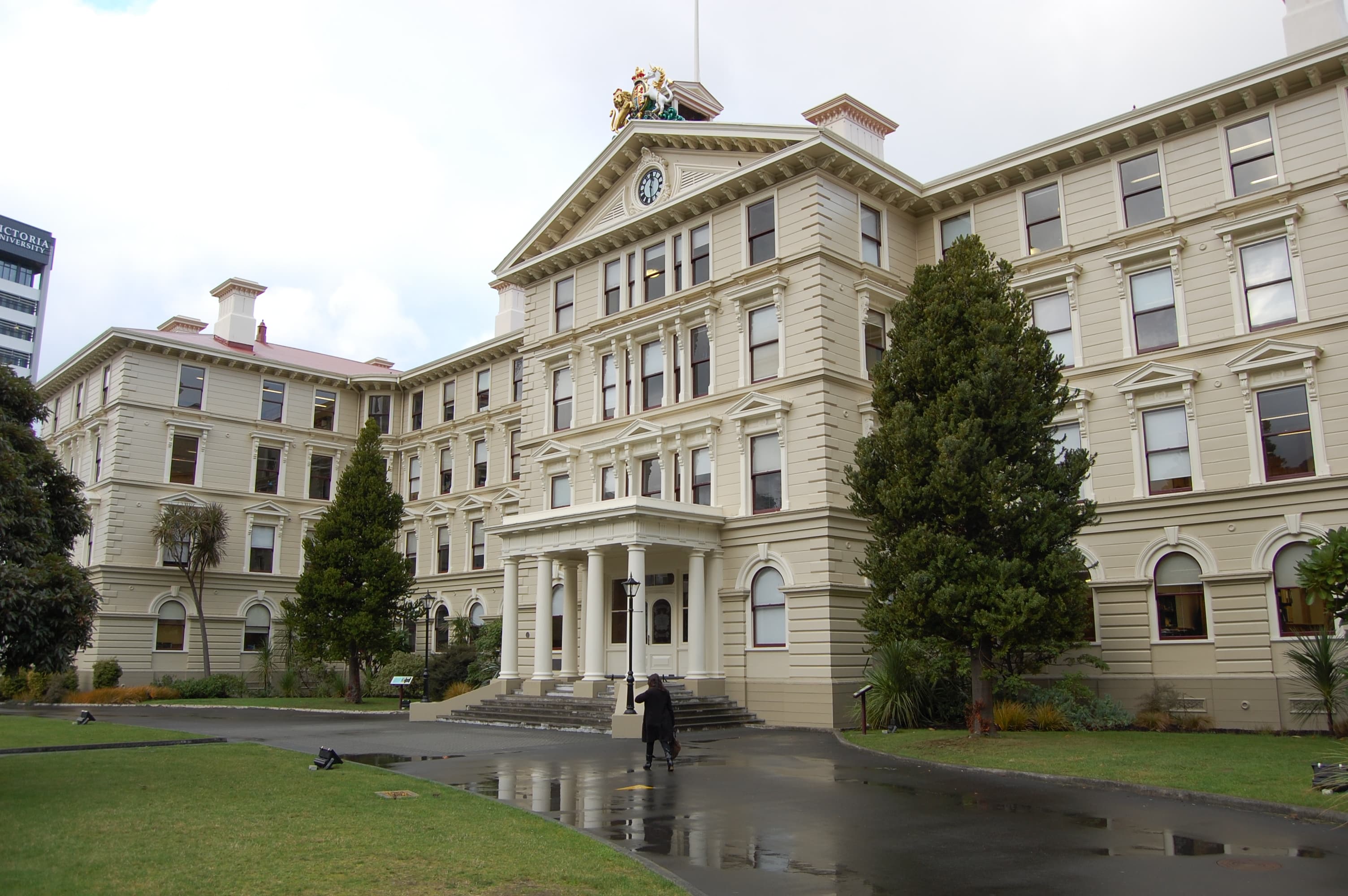
Old Government Buildings
Old Government Buildings — Historic site in Wellington City, wellington.
Historic Site · Monument in Wellington
Photo: Wikimedia Commons (CC-BY-SA)
 Written by Ben Cole· Updated Apr 2026
Find Nearby Accommodation
Hotels, apartments, hostels and luxury stays
We may earn a commission from bookings made through these links, at no extra cost to you.
About Old Government Buildings
Once the second-largest wooden building in the world (until 1998), built in 1876 in Italianate style. Originally housing the entire central government of New Zealand, this Category I heritage building now serves as the Victoria University of Wellington's Faculty of Law. A remarkable example of large-scale timber construction imitating stone.
Standing on Lambton Quay in Wellington's Pipitea suburb, the Old Government Buildings cut an impressive figure — all the more so when you learn that what appears to be stone is, in fact, timber. Completed in 1876 and designed in Italian Renaissance style, this is the second-largest wooden building in the world, a remarkable achievement of 19th-century construction that continues to define Wellington's historic streetscape nearly 150 years later.
The building is a Category I heritage structure, managed by Heritage New Zealand Pouhere Taonga, and today houses Victoria University of Wellington's Faculty of Law — a fitting second life for a building that once contained the entire machinery of New Zealand's central government.
History
When the Old Government Buildings were completed in 1876, they served as the administrative heart of New Zealand, housing the country's entire central government under one roof. The choice of timber was practical — New Zealand had abundant native timber resources — but the design ambition was anything but modest. Architects and builders worked to create a structure that closely mimicked the appearance of stone, applying Italian Renaissance detailing across a vast wooden frame.
The result was a building of considerable scale and sophistication that fooled many observers into believing it was masonry construction. That deception remains part of the building's enduring appeal; approaching it, the illusion holds remarkably well.
Its transition to a university law faculty has helped ensure the building's preservation, keeping it in active use rather than mothballed as a relic. The Category I heritage listing reflects its national significance — the highest level of protection available under New Zealand heritage law.
What to See and Do
The exterior is freely accessible at any time and rewards careful observation. The Italian Renaissance detailing — the rusticated base, the colonnaded facades, the ornate window surrounds — is most striking when you get up close and examine how it has all been rendered in wood. Bringing a zoom lens or binoculars will help you appreciate the finer architectural details from a distance.
Interior access is limited given the building's current use as an active university faculty. If you're hoping to see inside, it's worth contacting Victoria University of Wellington in advance to enquire about any available tours or access periods.
The building lends itself naturally to an architectural photography session, and for those interested in New Zealand's political and governmental history, simply standing before it offers a tangible connection to the country's 19th-century administrative past.
Getting There and Access
The Old Government Buildings are located in Pipitea, approximately 1 kilometre north of Parliament Buildings, making them straightforward to reach from central Wellington on foot. Expect around a 15 to 20-minute walk from the downtown core.
Wellington's Metlink bus network serves the surrounding area, and the building is accessible by vehicle via Aitken Street. On-site parking is available through Victoria University's campus facilities, though spaces may be restricted during semester — check signage when you arrive. Street parking on the surrounding Pipitea streets is also an option, and parking is generally free after hours and on weekends.
The site is wheelchair accessible and pram friendly, with the exterior viewable without any physical barriers.
Best Time to Visit
The exterior can be visited at any time of year and in any season — the building photographs well in both autumn and spring light. Weekday mornings between 8am and noon tend to be quieter, making them the better choice if you want a more relaxed visit or cleaner photographic compositions without heavy foot traffic. Midday light can be harsh on the building's pale facade, so earlier in the morning or late afternoon will produce better results for architectural detail shots.
Visitor Tips
- The building is best appreciated on foot and up close — don't just photograph it from across the road
- If interior access matters to you, contact Victoria University of Wellington before your visit to check current arrangements
- There are no food or café facilities at the site itself; central Wellington's cafes are all within easy walking distance
- Combine this stop with a visit to Parliament Buildings, which are just a kilometre south, for a broader look at Wellington's governmental heritage
- Parking during university semester hours may be limited — arriving early or visiting on weekends simplifies this considerably
Getting There
Located in the Pipitea suburb of Wellington city centre, approximately 1 km north of Parliament Buildings. Accessible by vehicle via Aitken Street or by Wellington's frequent bus network (Metlink services nearby). Walkable from downtown Wellington (15-20 minute walk).
Parking
On-site parking available. University campus parking facilities present; may be restricted during semester — check Victoria University signage. Street parking also available on surrounding streets in Pipitea. Free parking after hours and weekends.
Visitor Tips
- •Exterior is viewable anytime, so photograph it during golden hour for best architectural shots
- •Interior access is limited — check with Victoria University of Wellington for current tours or special access periods
- •The Italian Renaissance detailing is best appreciated up close; bring binoculars or zoom lens for architectural photography
- •Combine with nearby Parliament Buildings and Museum of New Zealand Te Papa Tongarewa for a full heritage morning
- •Weekday mornings are quieter than weekends for photography
Find Nearby Accommodation
Hotels, apartments, hostels and luxury stays
We may earn a commission from bookings made through these links, at no extra cost to you.
Quick Facts
At a Glance
The Place
- Significance
- National
Plan Your Visit
- Entry
- Free
- Duration
- 30 minutes - 1 hour
- Best Time
- Weekday mornings (8am-12pm) for quieter photography and clearer views. Any season works, though autumn and spring offer best lighting. Avoid midday harsh sunlight for architectural detail photography.
- Hours
- Exterior viewable anytime, interior limited access
Location
- Region
- Wellington City
- State
- Wellington
Good to Know
Highlights
Activities
Family & Visitor Info
- Ages
- All ages
- Shade/Cover
- Limited shade
- Pram Friendly
- Yes
Food & Drink
No food facilities on-site; nearby Wellington city centre has abundant cafes and restaurants within walking distance
Features
Facilities
Nearby
Campsites(5)
Find Nearby Accommodation
Hotels, apartments, hostels and luxury stays
We may earn a commission from bookings made through these links, at no extra cost to you.