Karlu Karlu (Devils Marbles) Conservation Reserve
Karlu Karlu
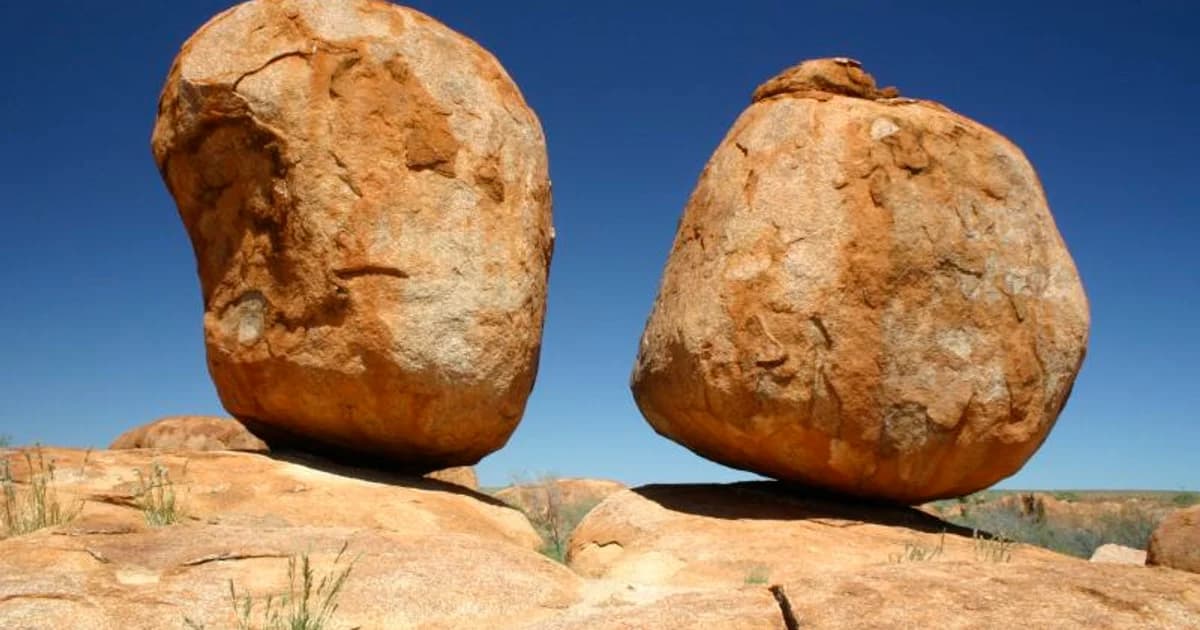
Karlu Karlu (Devils Marbles) Conservation Reserve — Karlu Karlu is a collection of giant balancing granite boulders scattered across a shallow valley, formed by millions of years of weathering and erosion.
Natural Landmark · Rock Formation in Northern Territory

Stays near Karlu Karlu (Devils Marbles) Conservation Reserve
Find Nearby Accommodation
Hotels, apartments, hostels and luxury stays
We may earn a commission from bookings made through these links, at no extra cost to you.
About Karlu Karlu (Devils Marbles) Conservation Reserve
Karlu Karlu is a collection of giant balancing granite boulders scattered across a shallow valley, formed by millions of years of weathering and erosion. The Warumungu people consider this a sacred site — the rounded boulders are the eggs of the Rainbow Serpent. The boulders glow orange-red at sunrise and sunset, making this one of the most photogenic spots in the [Northern Territory](/au/places/nt/northern-territory).
Karlu Karlu (Devils Marbles) Conservation Reserve sits 105 kilometres south of Tennant Creek along the Stuart Highway, in the vast open landscape of the Northern Territory's Barkly Region. This 18-square-kilometre reserve contains one of Australia's most striking geological formations — hundreds of giant rounded granite boulders, some balanced improbably on one another, scattered across a shallow valley as if placed there deliberately.
The site carries two names that reflect its dual significance. To the Warumungu people, this is Karlu Karlu — a place of deep spiritual importance where, according to their Dreaming stories, the boulders represent the eggs of the Rainbow Serpent. The colonial name "Devils Marbles" gives a sense of the formation's visual drama but says nothing of its cultural weight. Both names are used today, though Karlu Karlu is increasingly recognised as the primary designation.
History
The boulders themselves are the result of millions of years of geological process. Granite formed deep underground was gradually exposed by erosion, and over time the natural process of exfoliation — where layers of rock peel away due to temperature fluctuation and weathering — produced the distinctive rounded shapes you see today. What looks like a precarious balancing act is actually the product of ancient, patient geology.
For the Warumungu people, Karlu Karlu has been a significant place long before European settlement. The conservation reserve was gazetted to protect both the geological formation and its cultural importance, acknowledging that the two are inseparable.
What to See and Do
The main draw is simply the boulders themselves — walking among them, you get a genuine sense of their scale. Some reach several metres in height, and the way they cluster and balance creates a landscape unlike anything else along the Stuart Highway corridor.
There are walking paths through the reserve, and while the main concentration of boulders is easily accessible, venturing beyond the central area reveals quieter formations that attract fewer visitors. The terrain is relatively flat, and wheelchair access is available, though the unsealed paths between boulders can be uneven in places.
Photography is a natural activity here, and the light does most of the work at the right time of day — the granite glows orange and red in the low sun of early morning and late afternoon. At midday, the boulders lose much of their colour and the heat becomes a significant factor.
After dark, the reserve offers exceptional stargazing. With virtually no light pollution in this part of the Territory, the night sky is clear and expansive. Camping overnight is the best way to take full advantage of both ends of the day.
Guided tour options are available if you'd prefer to explore the area with expert context — private guided tours from Darwin to Alice Springs include Karlu Karlu as a stop, which can add useful cultural and geological background to what you're seeing.
Getting There and Access
Karlu Karlu is located on the Stuart Highway, roughly halfway between Tennant Creek (105km north) and Wauchope. The turnoff is well-signposted and the access road is sealed. The reserve is open 24 hours, year-round, and entry is free.
If you're driving the Stuart Highway between Darwin and Alice Springs, the reserve makes a natural stop — it sits directly on the route and requires no significant detour.
Best Time to Visit
Sunrise and sunset are the best times to be here, both for the quality of light and for the more manageable temperatures. The boulders take on a deep orange-red colour in low light that is quite different from their appearance in the middle of the day.
If you're visiting in the warmer months (roughly October through March), be prepared for extreme heat. There is no shade in the reserve beyond what the boulders themselves cast, and midday temperatures can be dangerous. Early morning visits are strongly recommended during this period.
The cooler months from May to August are generally the most comfortable for walking and spending extended time outdoors.
Visitor Tips
A few practical points worth knowing before you arrive:
- Bring your own water. There is no potable water supply on site. This is particularly important in summer and if you're camping.
- Do not climb the boulders. Karlu Karlu is a sacred site for the Warumungu people, and climbing on the rocks is disrespectful and prohibited.
- Consider camping overnight. The campsite has toilets and a picnic area, and staying the night allows you to catch both sunrise and sunset in a single visit — by far the most rewarding way to experience the site.
- Explore the less-visited areas. The formations beyond the main viewing area are worth the extra walk and tend to be quieter.
- Stargazing is exceptional. If clear skies coincide with your visit, the absence of light pollution makes for remarkable night viewing.
Information boards throughout the reserve provide context about both the geology and the Warumungu Dreaming stories associated with the site.
Warnings
Getting There
Location and map
105km south of Tennant Creek on the Stuart Highway. Well-signposted turnoff to the east. Sealed road all the way.
Visitor Tips
- •Camp overnight for sunrise and sunset in the same visit — the colours are extraordinary
- •Do not climb on the boulders — this is a sacred site for the Warumungu people
- •Explore beyond the main area for less-visited formations
- •Bring your own water — no potable water on site
- •Stargazing is world-class with virtually no light pollution
Find Nearby Accommodation
Hotels, apartments, hostels and luxury stays
We may earn a commission from bookings made through these links, at no extra cost to you.
Quick Facts
At a Glance
Identity
- Traditional Name
- Karlu Karlu
- Also Known As
- ["Devils Marbles"]
The Place
- Area
- 18.15 km²
- Significance
- National
Plan Your Visit
- Entry
- Paid
- Duration
- 1-2 hours
- Best Time
- Sunrise and sunset for dramatic lighting; avoid midday heat in summer
- Hours
- Open year-round, 24 hours
Location
- Area
- Davenport
- Region
- Alice Springs
- State
- Northern Territory
Good to Know
Highlights
Activities
Features
Facilities
Travellers also visited
Tap + to build a trip
Find Nearby Accommodation
Hotels, apartments, hostels and luxury stays
We may earn a commission from bookings made through these links, at no extra cost to you.