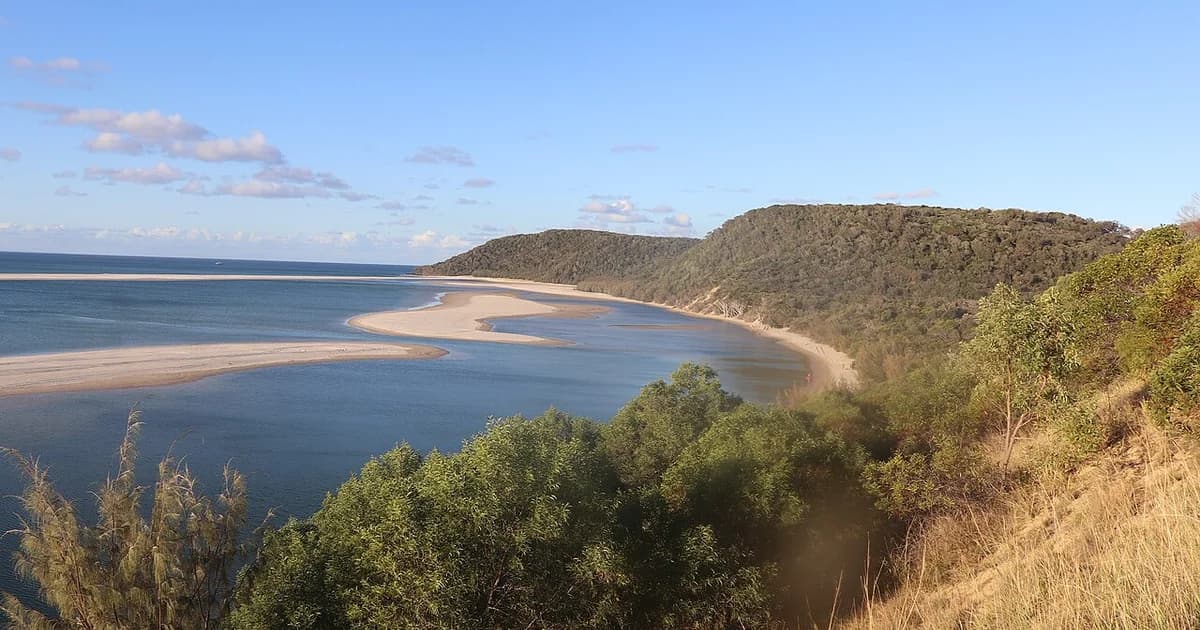
Double Island Point
Double Island Point is a remote rocky headland at the northern end of the [Rainbow Beach](/au/places/qld/rainbow-beach) Coloured Sands…
Natural Landmark in Queensland

Stays near Double Island Point
Find Nearby Accommodation
Hotels, apartments, hostels and luxury stays
We may earn a commission from bookings made through these links, at no extra cost to you.
About Double Island Point
Double Island Point is a remote rocky headland at the northern end of the [Rainbow Beach](/au/places/qld/rainbow-beach) Coloured Sands coast, accessible only by 4WD along the beach from Rainbow Beach. The headland features a heritage lighthouse (1884), dramatic views over the [Coral Sea](/au/places/qld/coral-sea), one of Queensland's best surf breaks, and the meeting point of the Great Sandy Strait and Pacific Ocean. The coloured sand cliffs below — in over 72 shades from white to deep red — are a striking geological formation.
Tours and Experiences


Double Island Point is a remote rocky headland at the northern tip of the Rainbow Beach Coloured Sands coast, where the Great Sandy Strait meets the Pacific Ocean. It's the kind of place that rewards the effort required to reach it — not because it's particularly difficult, but because the 4WD-only beach access keeps the crowds thin and the landscape largely undisturbed.
The headland sits roughly 17 kilometres north of Rainbow Beach along the beach itself, and it combines a working heritage lighthouse, striking geological formations, and one of Queensland's more respected surf breaks in a single location. Entry is free, and a visit of two to four hours gives you time to take it all in.
What to See and Do
The coloured sand cliffs are the first thing that demands your attention. Stretching along the base of the headland, the cliffs display over 72 distinct shades — from bright white through ochre, rust, and deep red — the result of millions of years of mineral weathering in the rock layers. It's an unusual geological feature, and one that gives the broader Rainbow Beach area its name.
From the top of the headland, the views extend across the Coral Sea and back down the coloured sands coastline. The meeting point of the Great Sandy Strait and the open Pacific is visible here, and it's easy to understand why early European navigators found these waters hazardous.
The surf break at Double Island Point is well regarded among experienced surfers. It's a long left-hander that works best in south-east swells — the kind of wave that draws people from well beyond the Sunshine Coast region. That said, sharks are present in these waters, so it's worth being aware of current conditions and signage before entering.
Fishing is popular along the rocks and beach, and the headland itself makes for rewarding photography at various times of day, particularly when the angle of light catches the layered colours of the cliffs.
Guided surf lessons and stand-up paddleboard tours run out to Double Island Point from Rainbow Beach, which can be a good option if you'd prefer to experience the area with local knowledge or don't have your own 4WD.
History
The lighthouse at Double Island Point was constructed in 1884, built specifically to guide ships through the treacherous passage where the Great Sandy Strait meets the Pacific. It's heritage-listed and remains an active navigational aid. The structure is a tangible reminder of just how dangerous these waters were for 19th-century shipping — the convergence of currents, shallow sandbars, and open-ocean swells made this stretch of Queensland coast genuinely perilous.
The coloured sand cliffs have their own geological history, laid down over vast timescales through the weathering of mineral-rich rock. The formations here are part of the same landscape that makes Rainbow Beach distinctive, though Double Island Point represents their most dramatic expression.
Getting There and Access
Double Island Point is approximately 240 kilometres north of Brisbane. The route takes you via Gympie to Rainbow Beach, where the sealed road ends and beach driving begins.
From Rainbow Beach, the drive to the point is around 17 kilometres along the beach — but this section is 4WD only, and critically, it is only accessible within approximately two hours either side of low tide. Attempting it outside this window risks becoming stranded as the tide cuts off the beach track.
Before you head out, check tide charts and confirm conditions at the Rainbow Beach Queensland Parks and Wildlife Service (QPWS) office. This is a straightforward but important step — tidal timing genuinely determines whether you can complete the trip.
There are no facilities at the point itself, so carry everything you need: water, food, fuel, and any emergency supplies appropriate for a remote coastal drive.
Dogs are permitted on the beach section of the drive.
Best Time to Visit
April through October is the recommended window for visiting. Conditions are generally more settled during these months, south-east swells are more consistent for surfing, and the cooler temperatures make the beach drive and exploration more comfortable. Low tide access is a requirement year-round, so checking tide tables applies regardless of when you visit.
Visitor Tips
- Confirm tide times at the Rainbow Beach QPWS office or via a reliable tide chart before setting out — don't rely on estimates
- Carry all supplies; there are no shops, toilets, or services at the headland
- If you're planning to surf, be aware that sharks are present in these waters
- The surf break is best suited to experienced surfers in appropriate swell conditions
- If you don't have a 4WD, tour operators based in Rainbow Beach run guided experiences to the point, including surf lessons and paddleboard tours
Warnings
Getting There
Location and map
Drive to Rainbow Beach via Gympie (240 km from Brisbane). From Rainbow Beach, 4WD access along the beach at low tide. Total beach drive is approximately 17 km to the point. Check tide charts — accessible only within 2 hours either side of low tide.
Nearest airport
Visitor Tips
- •Check tide tables at the Rainbow Beach QPWS office before driving. Dogs are permitted on the beach section. The surf break is a long left-hander best in south-east swells. Carry all supplies as there are no services at the point.
Find Nearby Accommodation
Hotels, apartments, hostels and luxury stays
We may earn a commission from bookings made through these links, at no extra cost to you.
Quick Facts
At a Glance
Identity
- Also Known As
- ["Bluff Point"]
The Place
- Significance
- State
Plan Your Visit
- Entry
- Free
- Duration
- 2–4 hours
- Best Time
- April to October (low tide access best)
- Hours
- Open 24 hours. 4WD required for beach access.
Location
- Area
- Cooloola
- Region
- Fraser Coast
- State
- Queensland
Good to Know
Highlights
Activities
Features
Facilities
Travellers also visited
Tap + to build a trip
Find Nearby Accommodation
Hotels, apartments, hostels and luxury stays
We may earn a commission from bookings made through these links, at no extra cost to you.
Nearby
Campsites(5)
Trails(3)
Attractions(2)
Toilets(3)
Groceries(3)
Fuel(3)
Dump Points(5)
Freshwater - Great Sandy National Park
Free · 9.5km
Rainbow Beach Dump Point
Free · 10.6km
Tin Can Bay Caravan Dump Point
caravan-park · 18.4km
Tin Can Bay Dump Point
Free · 19.8km
Fraser Island Tooloora Crk
Free · 27.2km
State Forests(5)
National Parks(5)
Tin Can Inlet Fish Habitat Area
Nature Reserve · 15.2km
Womalah Resources Reserve
Nature Reserve · 16.9km
Pipeclay National Park
Nature Reserve · 19.3km
Kauri Creek Fish Habitat Area
Nature Reserve · 23.4km
Tarangau Station NRS Addition - Gazettal in Progress
Nature Reserve · 32.9km