
About Launceston Airport
Northern Tasmania gateway, Cradle Mountain, Tamar Valley wine, Bay of Fires and Launceston city. Single integrated terminal.
A single-terminal gateway to northern Tasmania
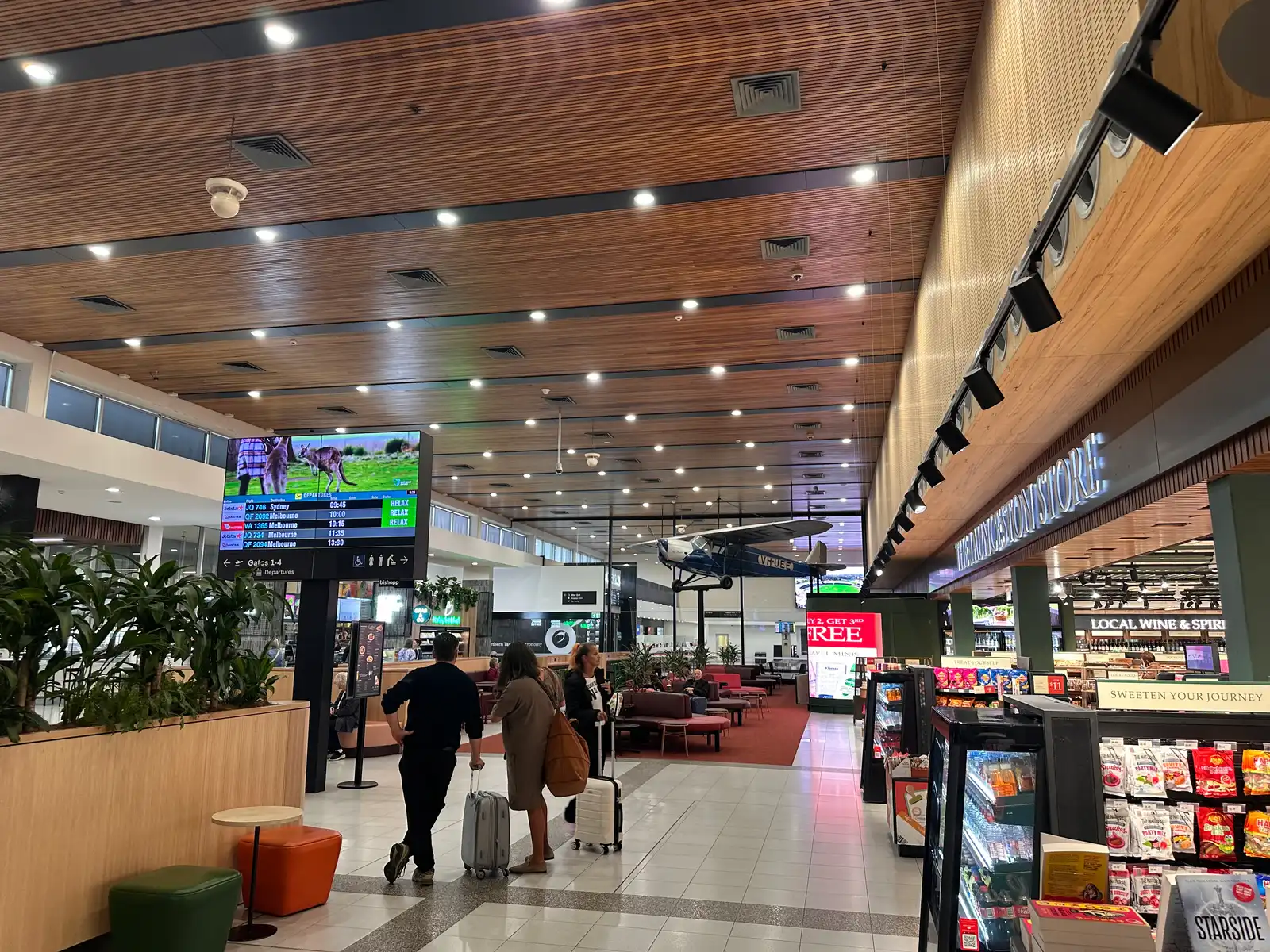 Launceston Airport (LST) sits 15 kilometres south of the city at Western Junction, where the Midland Highway meets the Tamar Valley. It's Tasmania's second-busiest airport after Hobart and Australia's 13th-busiest, handling 1,423,947 passengers in FY 2023-24, the first year over 1.4 million and a record for the airport. For most travellers heading to Cradle Mountain, the Tamar Valley wineries, the Bay of Fires or Launceston itself, this is the closest jet airport, and the natural starting point for a northern Tasmanian road trip.
The airport works as a single integrated terminal: check-in, security, departures and arrivals all under one roof, with short walks between every connection. The interior trades on local materials, Tasmanian timber slatted ceilings run the length of the concourse, lit by skylights and warm pendant lighting. A 2025 redevelopment, the largest in nearly 20 years, has been steadily reshaping the departures hall around new food and retail tenants.
Eat, drink and shop
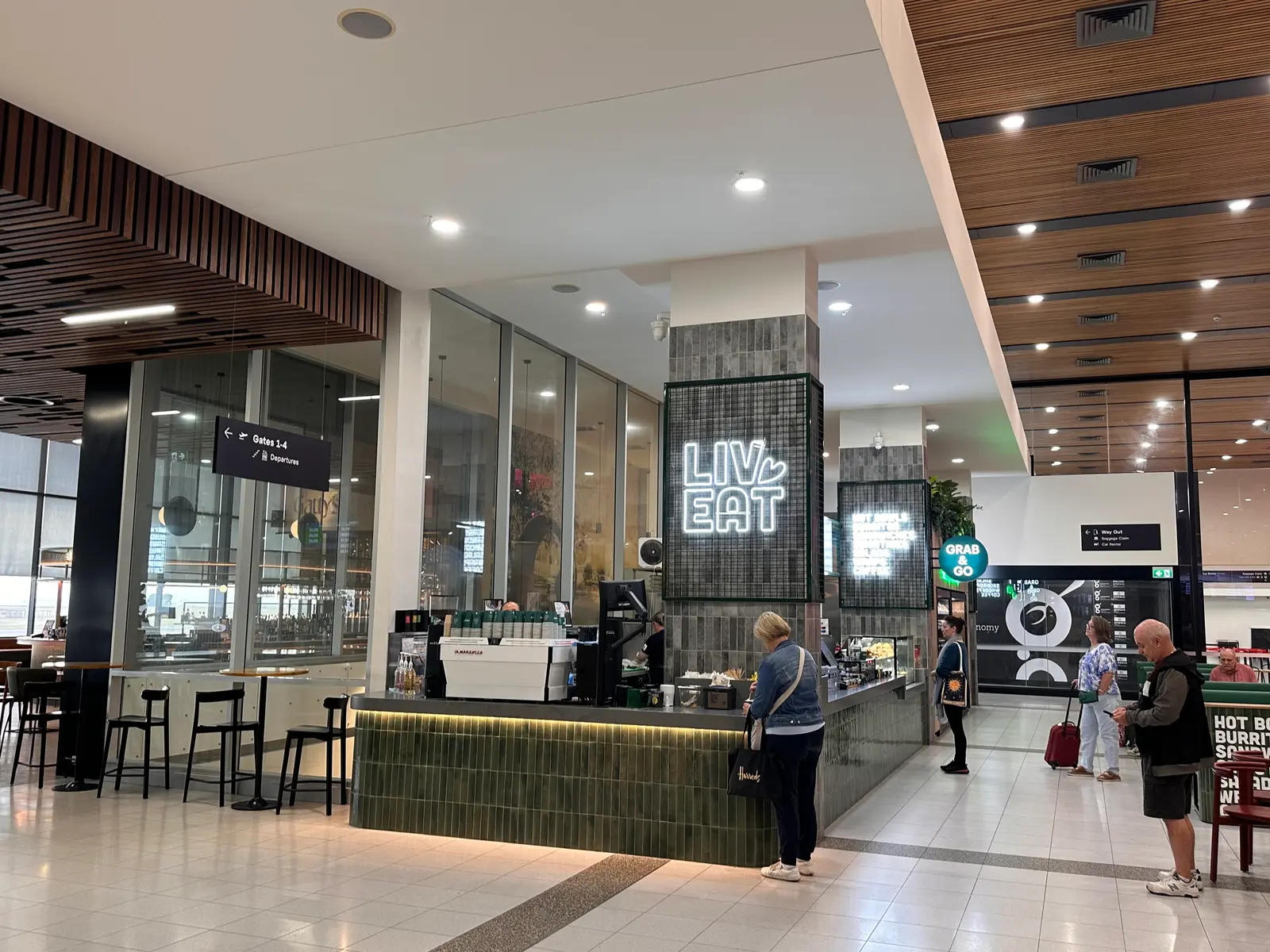 Liv Eat opened in July 2025, bringing the Tasmanian healthy-eating chain into the airport with salads, wraps, smoothies and barista coffee. It's positioned in the departures concourse near the central seating area, making it the easy pre-flight option for anyone wanting something lighter than a full meal.
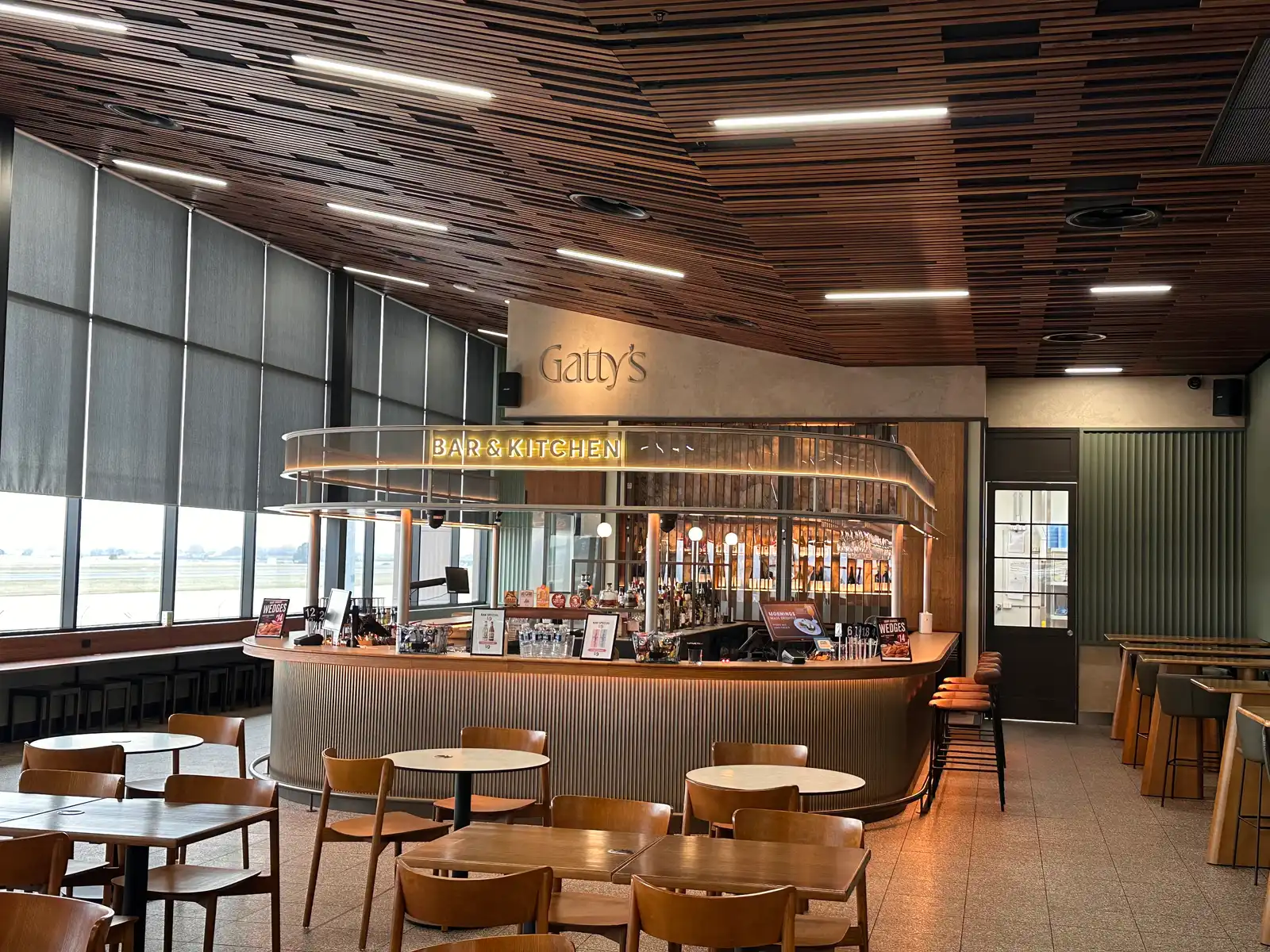
Gatty's Bar & Kitchen, also new for July 2025, is the airport's signature sit-down venue. It serves breakfast through dinner daily, with a focus on Tasmanian beverages: cool-climate wines from the Tamar Valley, Boag's on tap from down the road in Launceston, and Tasmanian whiskies. The name honours Harold Gatty, the Tasmanian-born aviator and "Prince of Navigators" (more on him below).
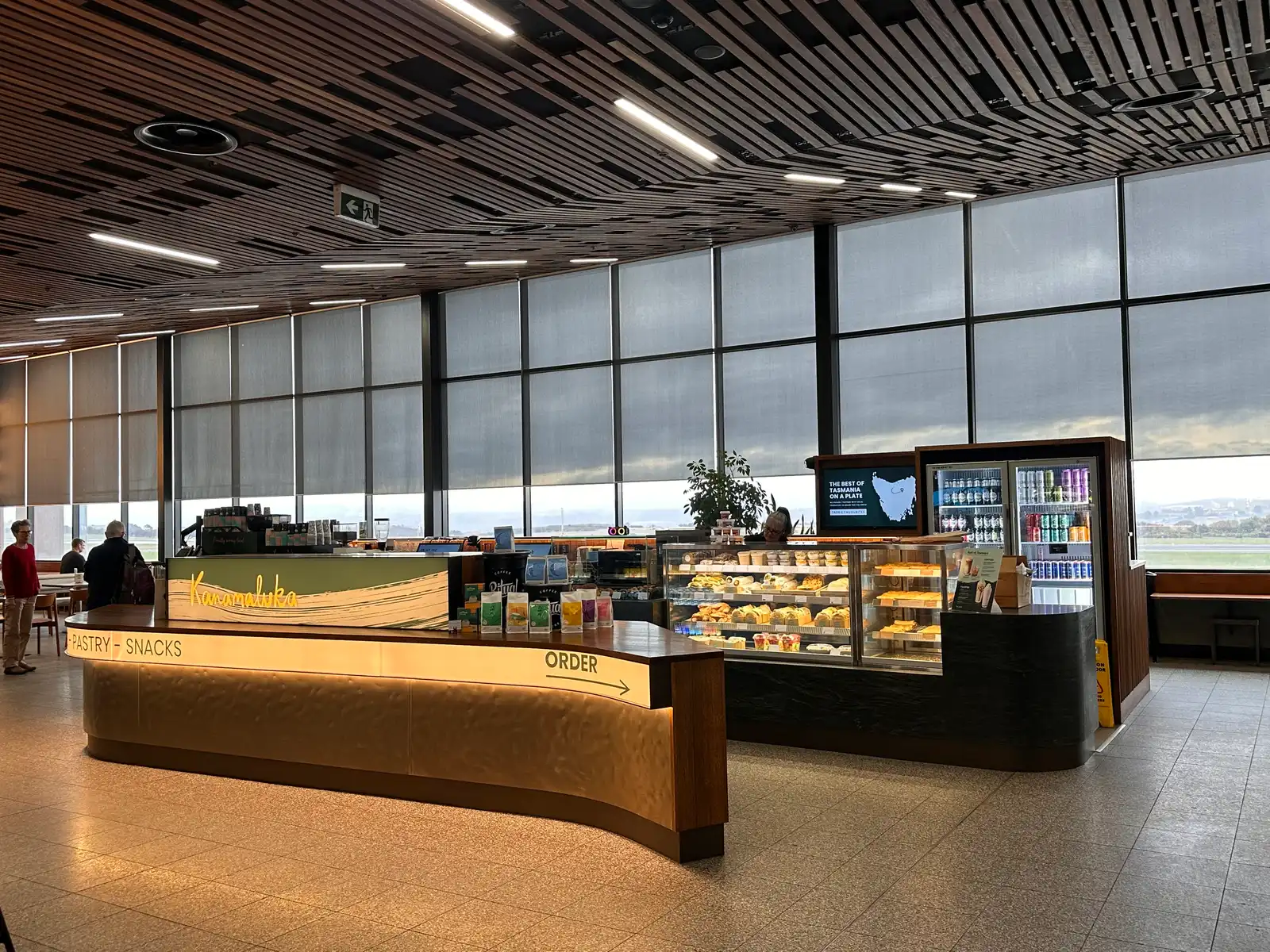
A pastry and snacks counter near the departure gates rounds out the grab-and-go options, with a glass cabinet of pies, sandwiches, slices and fresh coffee, useful for a final top-up after security.
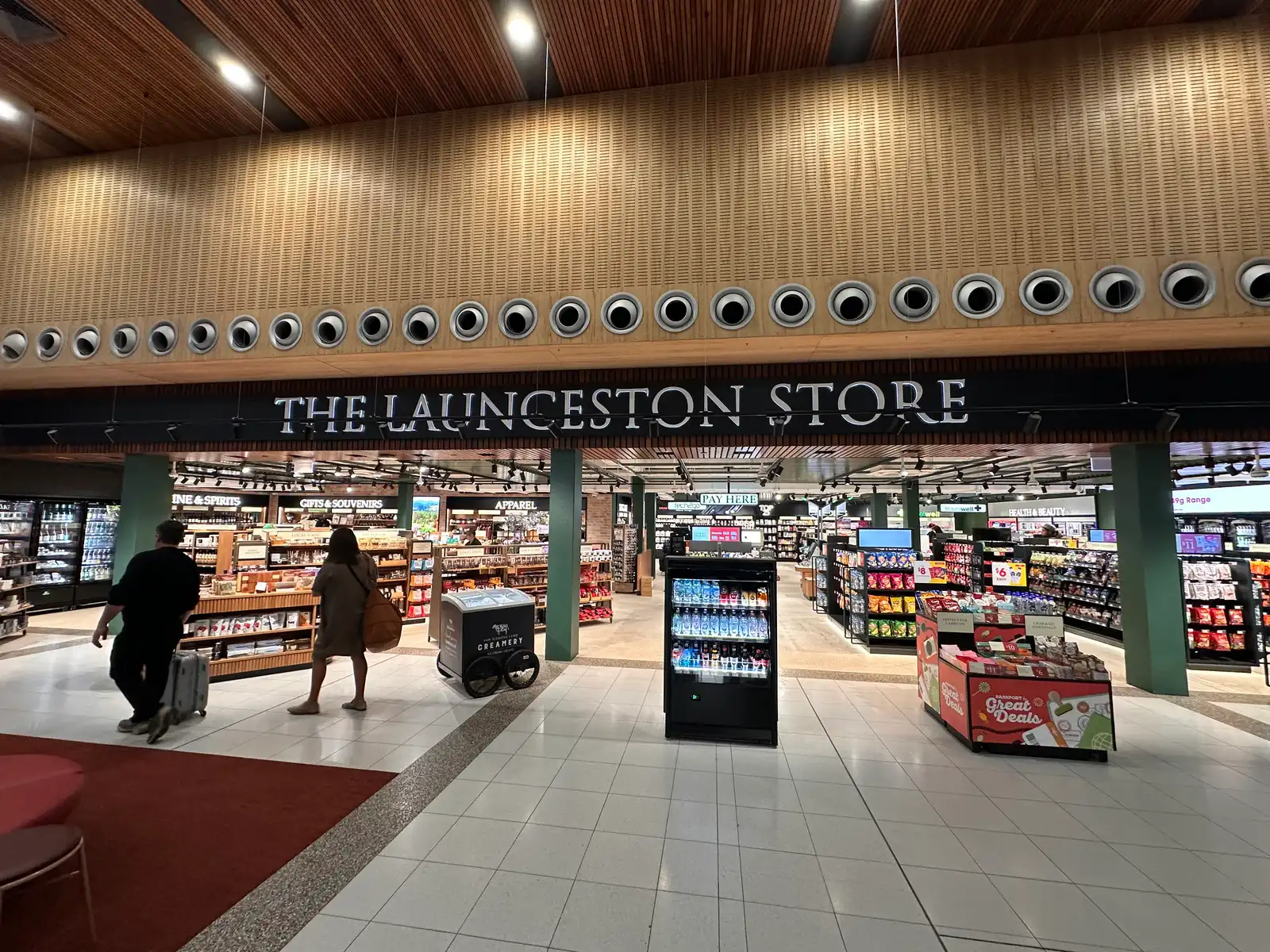
The Launceston Store is the airport's flagship retail space, expanded in the 2025 redevelopment to roughly 50% larger than its previous footprint. It's set up as a "store-in-store" concept showcasing Tasmanian artisan produce, cool-climate wine, Tasmanian whisky and gin, leatherwood honey, art and craft. If you forgot to pick up a souvenir from your trip, this is the recovery shot.
Lounges
 The Qantas Club Lounge is the airport's only paid lounge, located landside before security near the check-in counters (an unusual layout, you'll need to leave the lounge to clear security). It's compact, with around 23 seats, complimentary food and beverages, and opens 90 minutes before each Qantas and QantasLink departure. Virgin Australia does not operate a lounge at Launceston.
Heritage on display: Miss Flinders
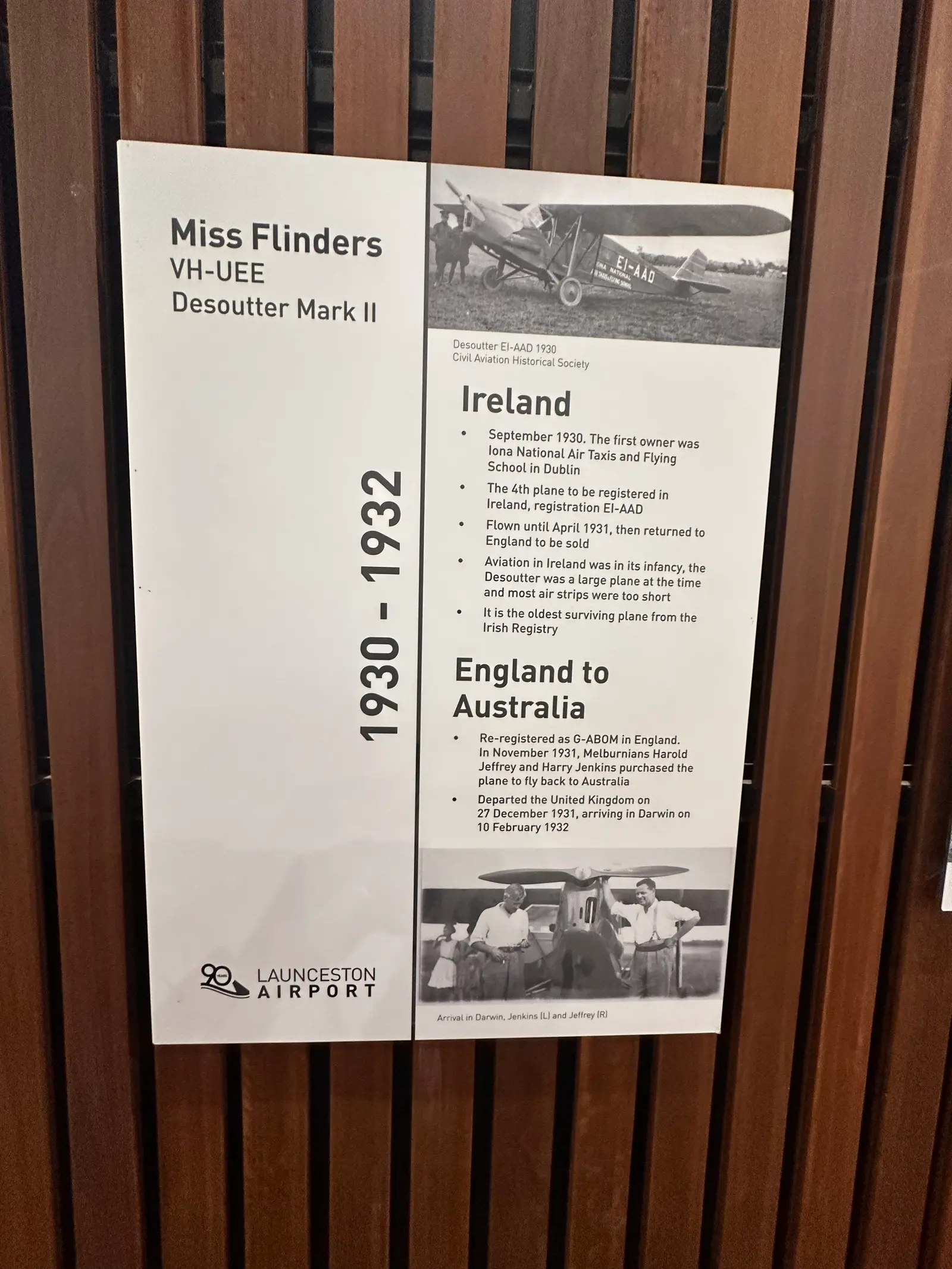
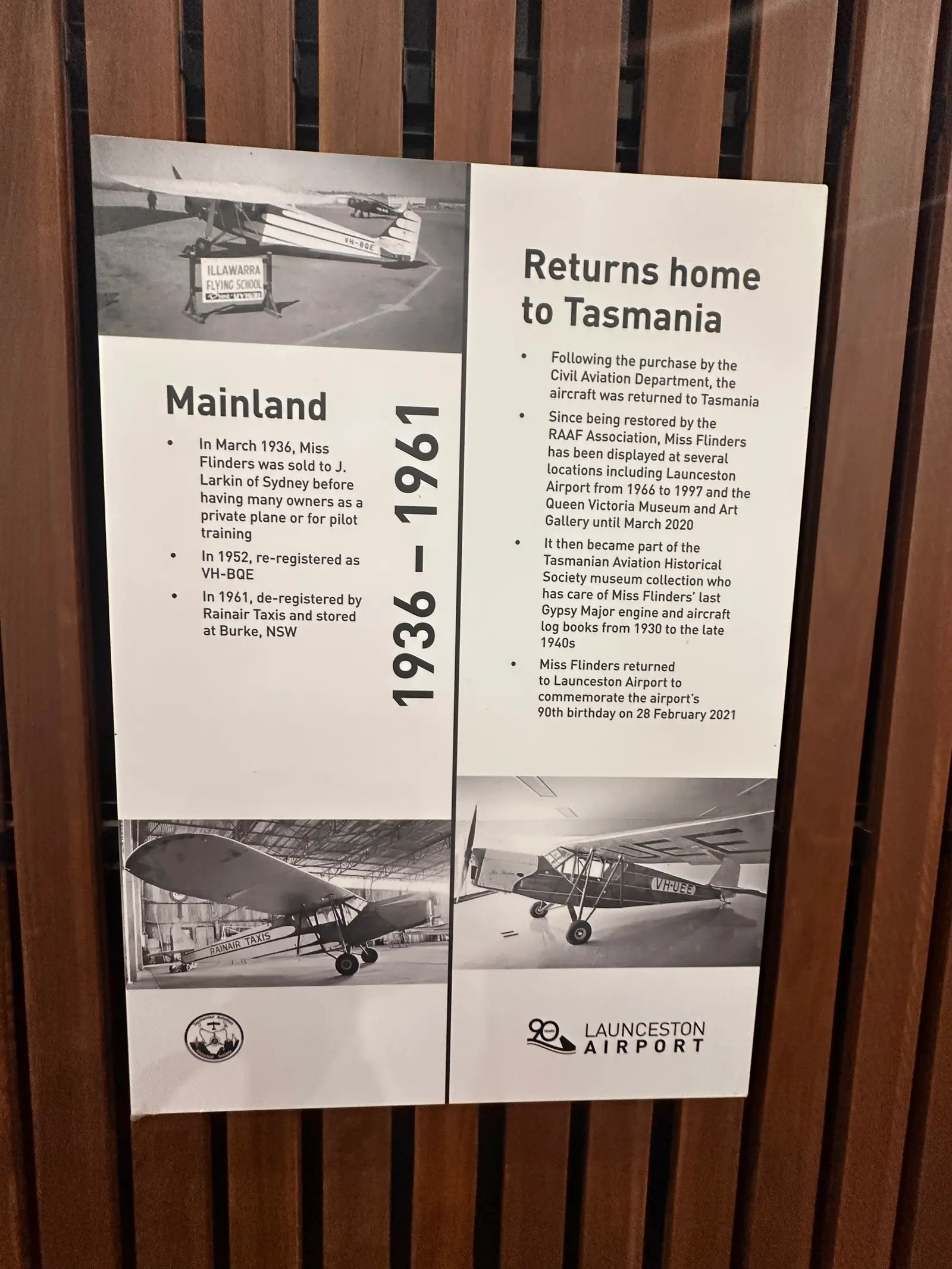
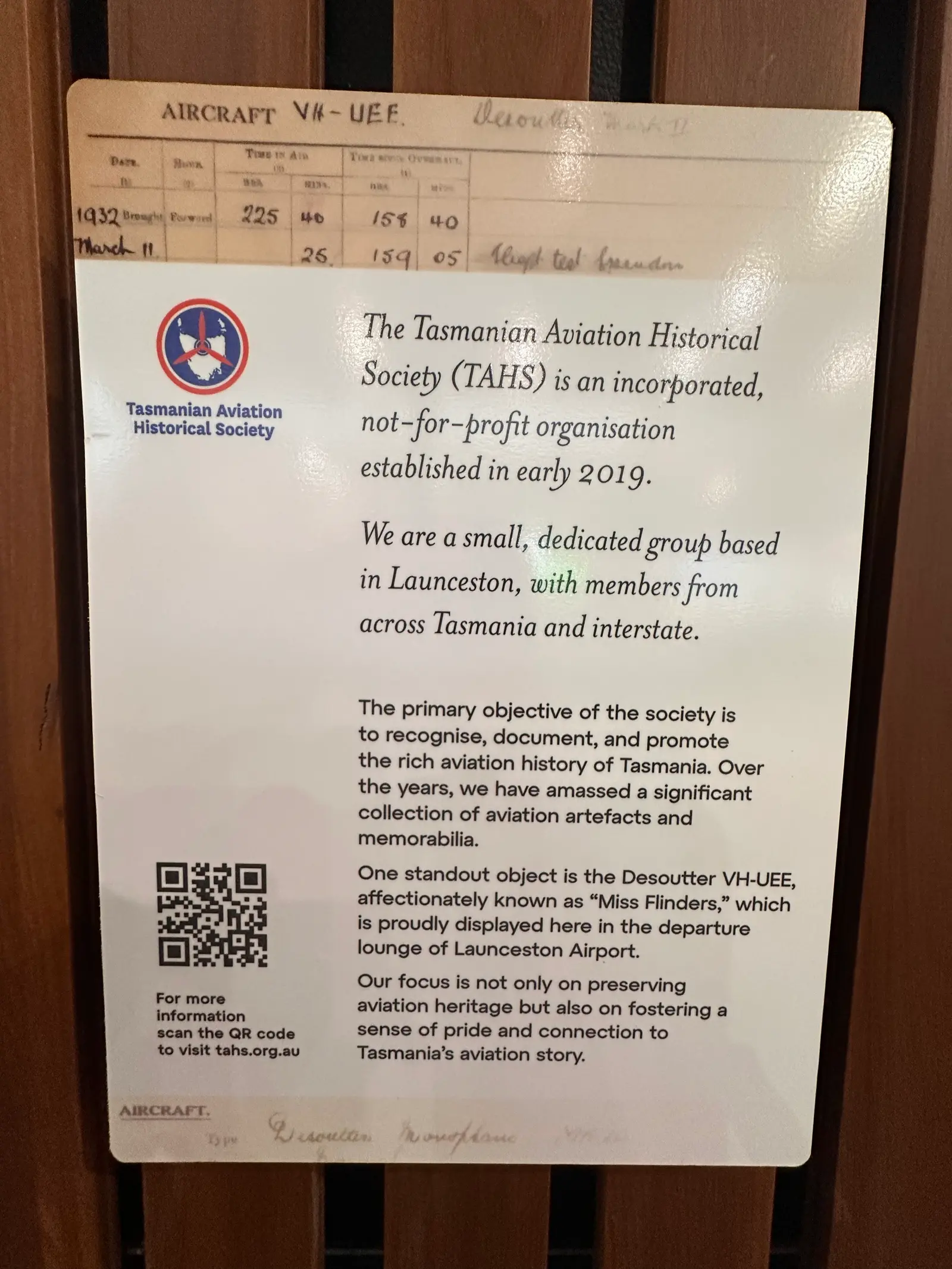
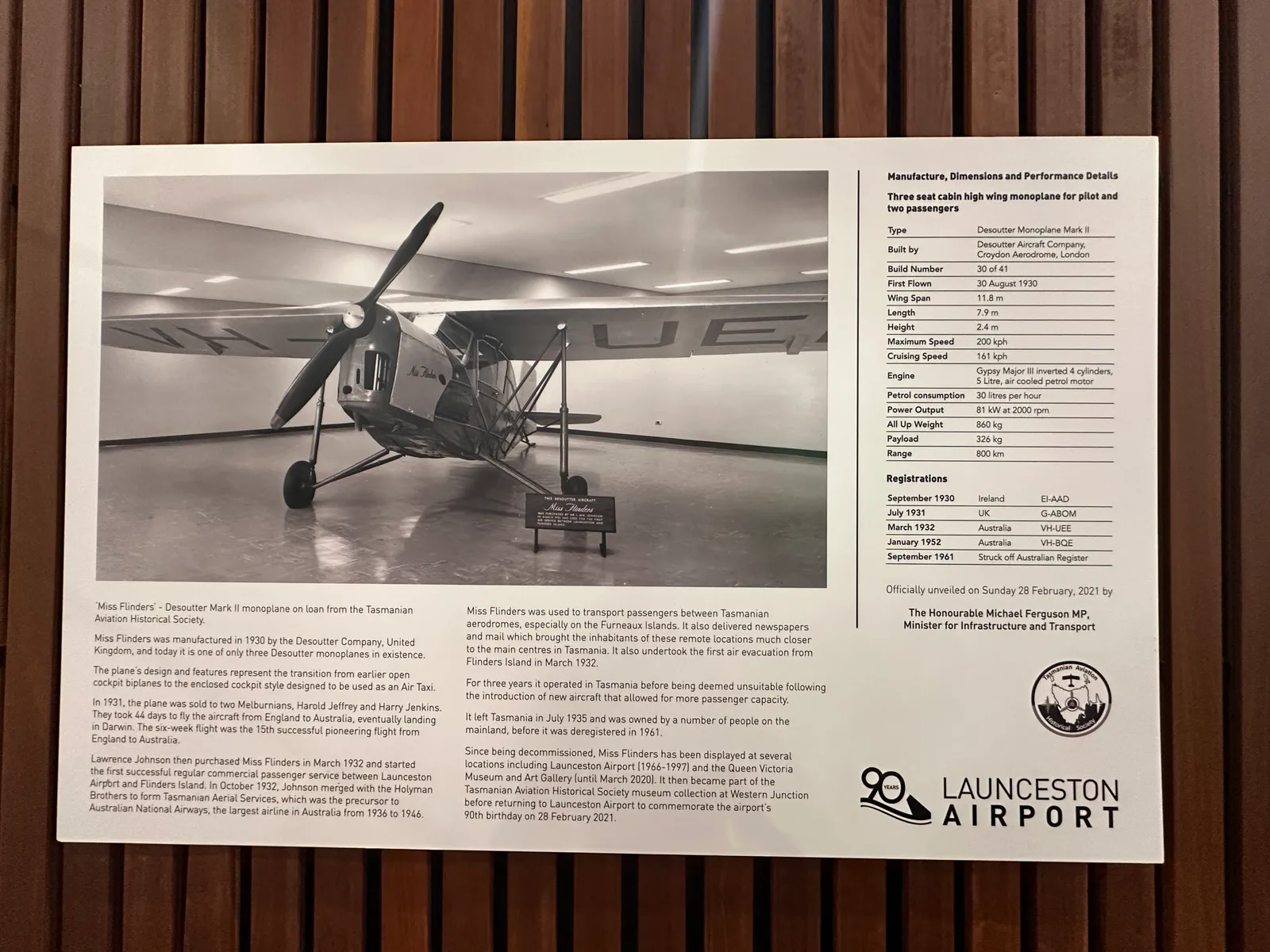 Suspended above the departures floor is Miss Flinders, a 1930 Desoutter Mark II monoplane (registration VH-UEE) that holds a unique place in Tasmanian aviation history. Curated by the Tasmanian Aviation Historical Society and raised onto its column in November 2021, it's worth a deliberate few minutes to circle and read the panels.
Built in 1930 by the Desoutter Aircraft Company at Croydon Aerodrome in London, Miss Flinders was first registered as EI-AAD in Ireland on 20 October 1930, the fourth aircraft and first commercial aircraft on the Irish civil register. After 18 months of mostly idle flying in Ireland, the plane was crated and shipped to Australia.
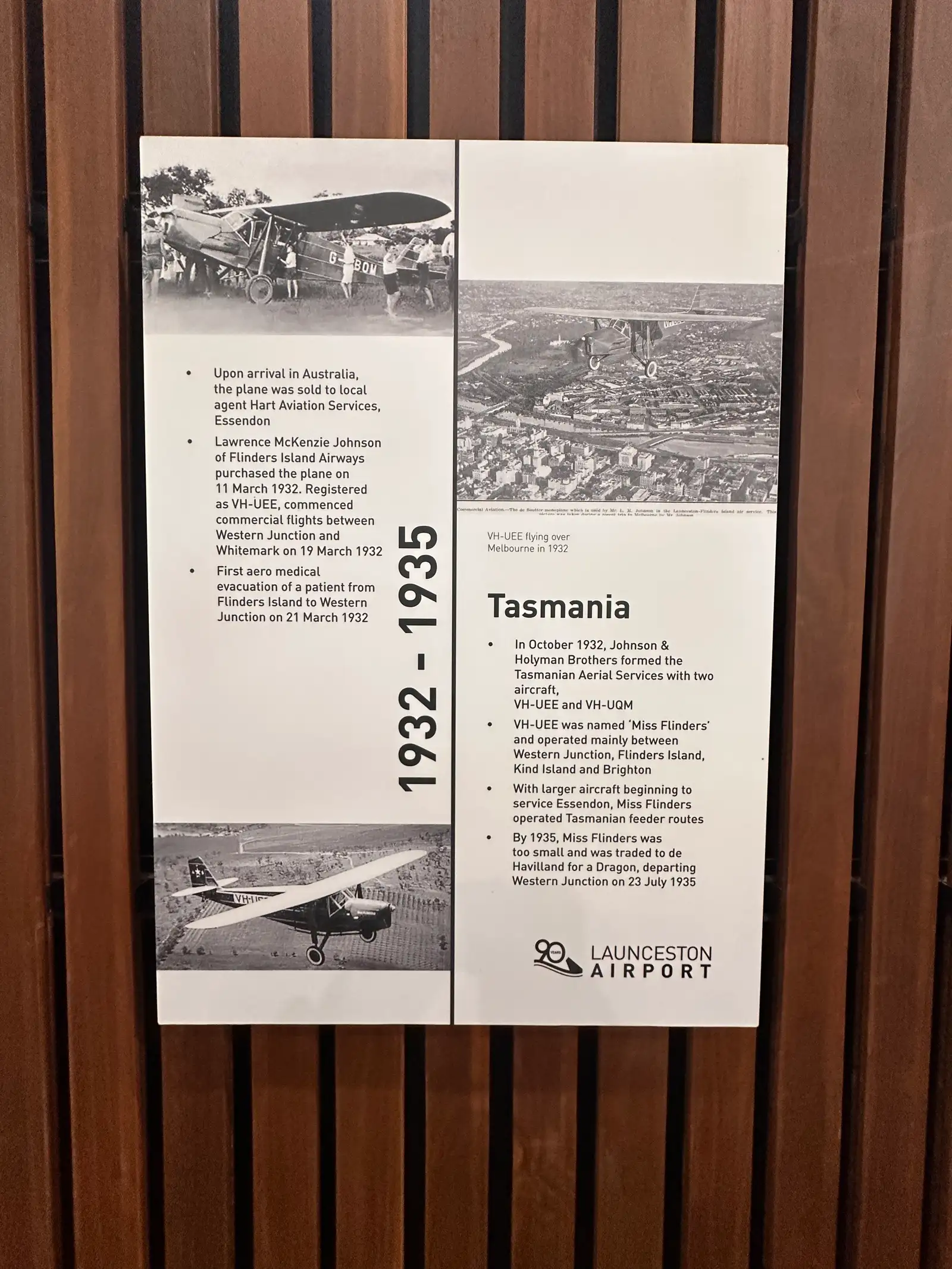
Re-registered as VH-UEE, it arrived in Tasmania in March 1932. On 19 March 1932, pilot Laurie Johnson flew it from Western Junction to Flinders Island carrying paying passengers, Tasmania's first commercial passenger flight. The aircraft was operated first by Tasmanian Aerial Services, then by Holyman's Airways after Johnson merged with the Holyman Brothers later that year. Holyman's eventually became Ansett-ANA. In 1933, Miss Flinders performed what is credited as Tasmania's first aero-medical evacuation, ferrying a patient from King Island.
By the late 1930s the aircraft was too small for the passenger loads on Bass Strait routes and was sold to mainland operators. After passing through several owners, it was struck from the Australian civil register in 1961 and went into long-term storage. The Queen Victoria Museum and Art Gallery in Launceston acquired it and undertook a careful restoration between 2010 and 2011.
The Tasmanian Aviation Historical Society took over custody in March 2020 and worked with Launceston Airport, the Tasmanian Government and the QVMAG to bring Miss Flinders home for permanent display. The aircraft was first reassembled in the terminal in February 2021 to mark the 90th anniversary of the airport's official opening, then raised onto its current column nine months later. It is now believed to be the oldest surviving aircraft from the Irish civil register anywhere in the world.
Harold Gatty, the navigator behind Gatty's Bar
 Born in Campbell Town, 70 kilometres south of the airport, in January 1903, Harold Gatty became one of the most influential aerial navigators of the 20th century. In June 1931 he flew around the world with American pilot Wiley Post in the Lockheed Vega Winnie Mae, completing the circumnavigation in 8 days, 15 hours and 51 minutes, a record at the time. Charles Lindbergh called him the "Prince of Navigators." Gatty later invented a ground-speed and drift indicator that became foundational to autopilot systems, and authored The Raft Book, a survival-navigation guide using sun, stars and birdlife that was standard issue in US Army Air Force life rafts during World War II. He refused US citizenship to remain Tasmanian; President Hoover had Congress pass a special law to allow him a senior US Air Force role anyway.
Western Junction at war: No. 7 EFTS
 The airfield's most consequential chapter began on 29 August 1940, when No. 7 Elementary Flying Training School (No. 7 EFTS) was formed at Western Junction as Tasmania's only RAAF aircrew training unit during World War II. It was part of the Empire Air Training Scheme, Australia's contribution to the British Commonwealth Air Training Plan, which trained tens of thousands of Allied aircrew across Australia, Canada, Rhodesia, South Africa and New Zealand to feed the air war over Europe and the Pacific.
 The first eleven de Havilland Tiger Moth biplanes arrived on 11 September 1940; flying training began nine days later. The school grew quickly, by late 1944 it operated a fleet of around 60 Tiger Moths from Western Junction's grass strips, with relief landing grounds at Nile, Annandale, Valleyfield and Quorn Hall scattered across the Northern Midlands. Trainees were billeted in Launceston and the nearby village of Evandale, forging a community bond that survives in local memory to this day.
 Cadets came through the school in 12-week intakes, a four-week initial assessment phase of about ten flying hours, followed by an eight-week advanced phase of around 65 hours. Those who soloed and passed went on to Service Flying Training Schools on the mainland and from there to operational squadrons in Europe, North Africa, the Mediterranean and the Pacific.
 By the time training was suspended in December 1944 and the school formally disbanded on 31 August 1945, 1,801 pilots had earned their wings at Western Junction. The cost was heavy. Roughly 600 of those graduates, about a third, were killed, in subsequent training accidents on the mainland or on operations across every Allied theatre. Among the decorations later won by Western Junction graduates were 3 Distinguished Service Orders, 32 Distinguished Flying Crosses, 2 Air Force Crosses, 4 Distinguished Flying Medals and 8 Mentions in Despatches; twelve became prisoners of war. Ten servicemen died on station at Western Junction itself, including the crew of Tiger Moth A17-560, which spun in near Longford on 11 June 1943.
 The school's physical footprint still shapes the airport. The RAAF erected several Bellman hangars, large pre-fabricated steel hangars to a 1936 British Air Ministry design, manufactured in Australia by Waddington Engineering, and two of those wartime Bellmans still stand today on the southern Freight and General Aviation operations area at Launceston Airport. They are among the last surviving pieces of WWII airfield architecture in Tasmania. After the war, three further RAAF hangars were donated to the Tasmanian Aero Club, and the long all-weather sealed runway that arrived in 1947-1949 was the upgrade that turned a wartime training base into a modern civil airport.
The story is commemorated in the Photo Mural and Propeller Memorial in the Launceston Airport car park, which honours both the ten who died on station and the hundreds of graduates lost overseas. A second No. 7 EFTS memorial was unveiled in Evandale village on 21 August 2010 to mark the 70th anniversary of the school's founding, with around 20 surviving veterans in attendance and a fly-past by the RAAF Roulettes. The Last Post is sounded at the airport memorial each Anzac Day.
Getting to and from the airport
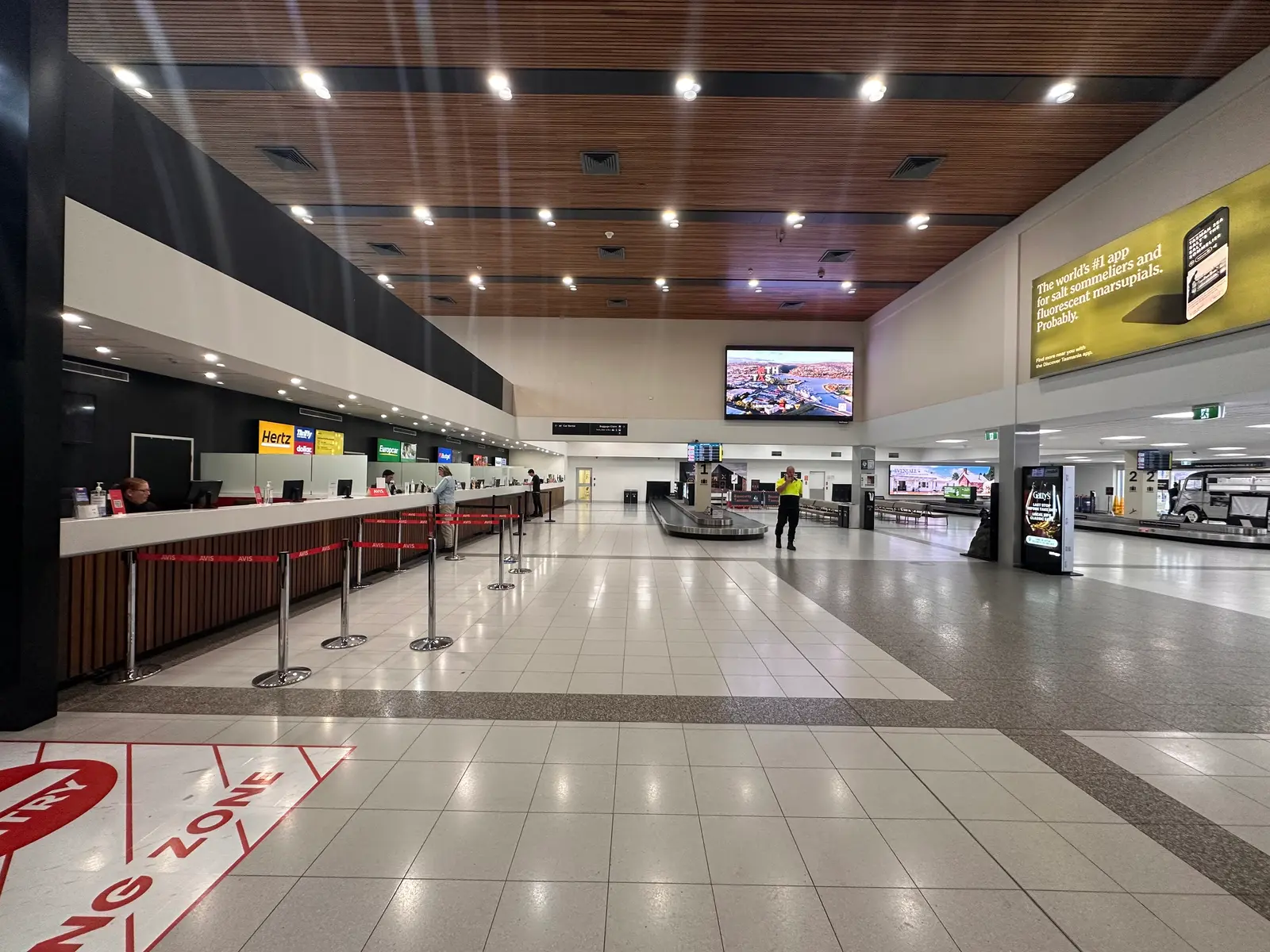 A hire car is essential if you're touring Tasmania, the island is built around road travel and public transport beyond the cities is limited. All major brands operate desks in the arrivals hall: Hertz, Avis, Budget, Europcar and Thrifty. Pick up the keys, walk to the dedicated rental return/pickup bays directly outside, and you're on Evandale Road within a few minutes.
If you don't need a car, a taxi rank sits outside the terminal exit, a CBD fare runs around $40-50, 20 minutes door-to-door. Uber operates in Launceston and is usually slightly cheaper. The Launceston Airport Shuttle Bus offers door-to-door private transfers; book ahead. A SkyBus pilot service to the city has run during high-demand periods (cricket fixtures, major events), check the SkyBus website close to your travel date. There is no scheduled public bus that stops at the terminal.
For drivers picking up arriving passengers, the 30-minute pickup zone is free once per day in the Short Stay (P3) car park.
Tasmanian biosecurity, what to declare
Tasmania is one of the few intra-Australian borders that operates a mandatory biosecurity inspection regime. Every arriving passenger, including those flying in from mainland Australia, must declare or surrender restricted items. The list covers fresh fruit and vegetables, plant material and seeds, soil, honey, certain seafood and animal products, and outdoor gear with traces of soil or vegetation: hiking boots, camping equipment, gaiters, tent pegs and bike tyres are common confiscation candidates.
The reason matters: Tasmania remains free of Phytophthora cinnamomi (a soil-borne pathogen that devastates native vegetation including the high-altitude communities around Cradle Mountain) and several other pests endemic on the mainland. From November 2025, both Hobart and Launceston airports operate produce x-ray scanners on arrival baggage. If you're carrying anything borderline, declare it, undeclared items detected during inspection attract on-the-spot fines, while declared items can usually be surrendered without penalty.
Connecting to the Tamar Valley, Cradle Mountain and beyond
Launceston Airport markets itself as the closest jet airport to a remarkable cluster of destinations:
- Cradle Mountain-Lake St Clair National Park, roughly 2 hours 15 minutes drive south via Sheffield (the most scenic route) or via Deloraine and the A5
- Tamar Valley wine region, 30 cellar doors along a 170-kilometre wine route. Josef Chromy Wines is just 5 minutes from the airport, an easy first stop. Further north, Tamar Ridge, Holm Oak, Pipers Brook and Bay of Fires Wines anchor the trail
- Bay of Fires, 2 hours 15 minutes northeast via the A3
- Wineglass Bay and Freycinet National Park, about 2 hours east
- Blue Derby mountain bike trails, 1 hour 30 minutes northeast in the Tasmanian highlands
- Cataract Gorge and Launceston city, 20 minutes north into the CBD
Plan your route before you leave the rental car bay; mobile coverage thins out quickly once you head into the parks.
Airport Layout
Runway configuration and terminal area for Launceston Airport.
Runways
3 runways • longest 1,981m • total 3,371m • Regional jet capable (e.g. Embraer 170, Bombardier CRJ-200)
| Designation | Length | Width | Surface | Headings | Lighted |
|---|---|---|---|---|---|
| 14R/32L | 1,981 m | 45 m | Asphalt | 146° / 326° | Yes |
| 14L/32R | 700 m | 18 m | Grass | 147° / 327° | No |
| 18/36 | 690 m | 18 m | Grass | 196° / 16° | No |
Security & screening at Australian airports
Recommended arrival times
- Domestic flights: arrive 60 minutes before departure
- International flights: arrive 2–3 hours before departure (longer for first-time international travellers)
What you can carry on
- Liquids, aerosols and gels (LAGs): containers up to 100ml for international flights, all in a single transparent 1L resealable bag. Domestic flights have no LAG restrictions on most airlines.
- Lithium batteries (in personal devices): allowed in carry-on only. Spare batteries up to 100Wh permitted in carry-on; batteries over 160Wh prohibited.
- Sharp items including scissors with blades over 6cm, knives, and tools must be packed in checked baggage.
Prohibited items
- Firearms (require declaration and approval)
- Explosives, flammable liquids, compressed gases
- Pepper spray, mace, tear gas
- Self-defence weapons including knuckle dusters
Full list: ABF prohibited items
International arrivals — biosecurity
Australia has strict biosecurity laws. Declare all food, plant material, animal products, soil, wooden items, and outdoor equipment on your Incoming Passenger Card. Fines start at AUD $626 and undeclared prohibited items can result in penalties up to $660,000 or visa cancellation. When in doubt, declare it.
Useful links
- Smart Traveller (DFAT) — travel advisories
- Australian Border Force — customs and biosecurity
- Aviation Security (Department of Infrastructure)
Specific to Launceston Airport
Modern CT-scanner security has been in place since December 2023, which generally means you can leave laptops, tablets and liquids inside your carry-on through screening, confirm with the screener on the day. Allow 60 minutes before a domestic departure (Qantas and Jetstar close check-in 30 minutes prior). The single security checkpoint is on the upper level of the departures concourse; queues move quickly outside peak Friday and Sunday windows.
Nearby Attractions
Quick Facts
Stay connected on arrival — Airalo eSIM
Skip airport SIM kiosks — install Airalo before you fly and activate the moment you land.

Scan to install on your phone
Quick Stats
- Class
- major regional
- Runways
- 3
- Longest runway
- 1,981 m
- Max aircraft
- Regional jet capable
- Elevation
- 171 m
- Annual passengers
- 1.4M(2024)
- Owner
- Australia Pacific Airports Corporation
At a Glance
Airport Codes
- IATA
- LST
- ICAO
- YMLT
Location
- City
- Launceston
- State
- Tasmania
- Timezone
- Hobart
Plan Your Visit
- Best Time
- Summer (Dec-Feb) for hiking. Autumn (Mar-May) for foliage. Winter (Jun-Aug) for snow at <a href="/au/attractions/tas/cradle-mountain">Cradle Mountain</a>.
- Hours
- 04:30 - 23:00 daily (terminal hours align with first and last scheduled flights)
Good to Know
Airlines
Car Hire
Highlights
Facilities
Find Nearby Accommodation
Hotels, apartments, hostels and luxury stays
We may earn a commission from bookings made through these links, at no extra cost to you.
Nearby
Trails(3)
Attractions(1)
Toilets(3)
Groceries(5)
Fuel(5)
Dump Points(2)
St Leonards Park
Free · 9.3km
Cressy Dump Point
Free · 18.7km