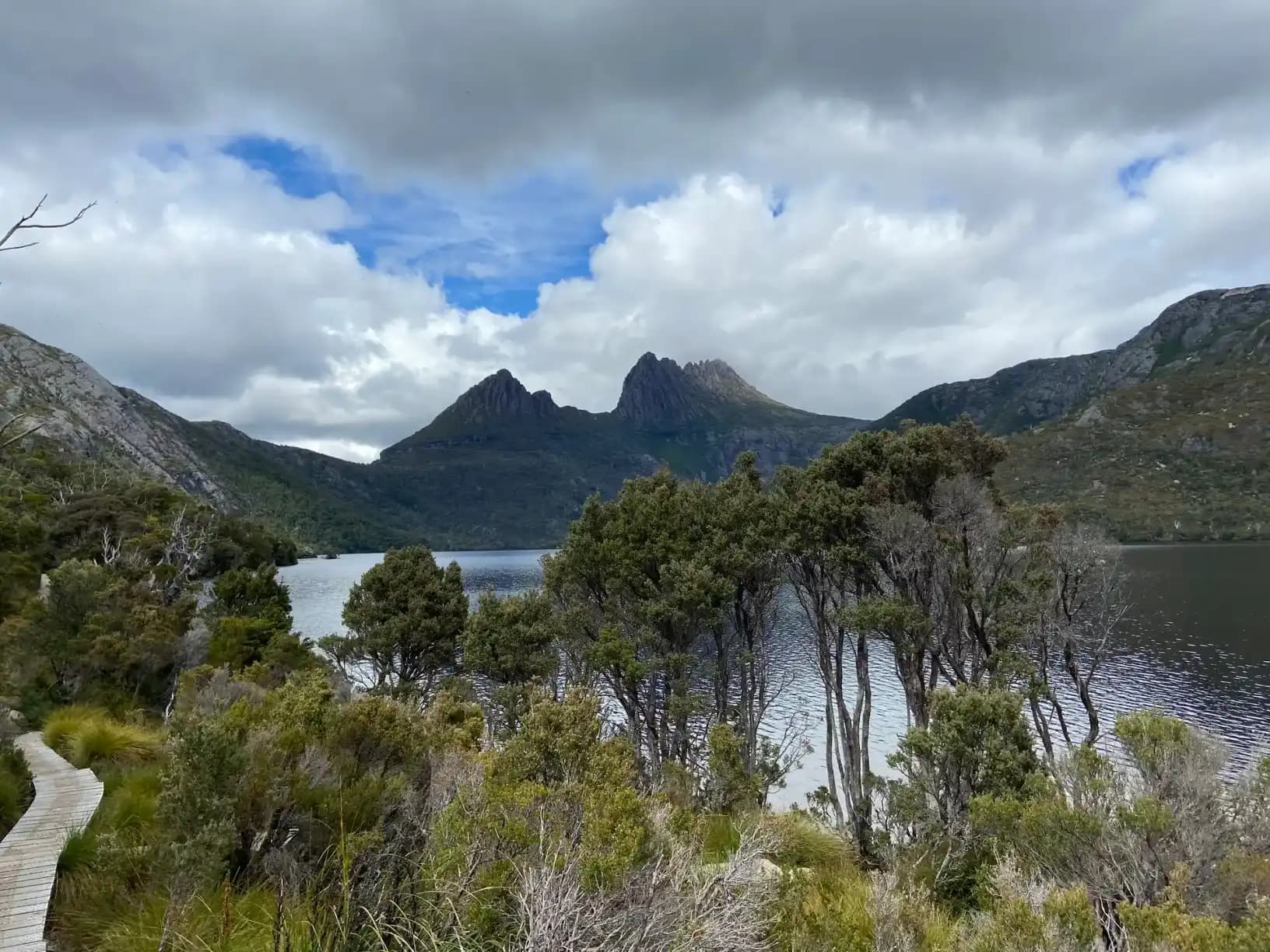
Cradle Mountain
Cradle Mountain · Cradle Mountain–Lake St Clair National Park
Photo: JF (All Rights Reserved)
Cradle Mountain
Cradle Mountain–Lake St Clair National Park · Cradle Mountain · Tasmania
At a Glance
About Cradle Mountain

Cradle Mountain is the postcard of Tasmania, a jagged dolerite skyline rising to 1,545 metres above the alpine plateau in Cradle Mountain–Lake St Clair National Park. You'll find it featured on more Tasmanian tourism posters than anything else, and once you see it from the boatshed at Dove Lake on a still morning, you'll get why.
The summit walk is no easy stroll. Trust me on this one, the final scramble up the boulder field from Kitchen Hut takes most walkers 2.5 to 3 hours return and demands a head for heights. Pro tip: start before sunrise. By 10am in summer the cloud often rolls in off the Southern Ocean and the view from the top is gone. The track to the summit is on the Summit Track, branching off the Overland Track at the saddle below.
If the summit isn't for you, the Dove Lake circuit (6 km, 2–3 hours) wraps the lake at the foot of the peak and gives you the same iconic view without the climb. Heads up: parking at Dove Lake closed permanently in 2022. You now park at the Cradle Mountain Visitor Centre and take the shuttle in (included in the park entry fee).
Cradle Mountain sits inside the Tasmanian Wilderness World Heritage Area, alongside ancient pencil pines that are some of the oldest trees in Australia, alpine heath, and tarns scooped out by the last ice age. The dolerite columns were squeezed up from below 175 million years ago when the supercontinent of Gondwana began to break apart, then sharpened by glaciers into the cradle shape you see today.
The mountain is also the northern anchor of the Overland Track, Australia's most famous multi-day hike. Six days, 65 kilometres south to Lake St Clair. If you've only got a day, the Dove Lake circuit and the lookout from Marions Lookout get you the best of what makes this place special.
Cradle Mountain Safety & Warnings
["hypothermia_risk_carry_warm_waterproof_layers","rapidly_changing_alpine_weather","summit_track_grade_5_expert_only","snow_and_ice_in_winter","limited_mobile_reception","winter_road_closures_possible","wildlife_on_roads_at_dusk","no_camping_at_dove_lake"]
Getting to Cradle Mountain
By Air: The nearest major airport is Launceston Airport (code LST), about 140 kilometres and a 2 to 2.5 hour drive away. Direct flights operate from Melbourne and Sydney. Devonport Airport (code DPO) is closer at around 85 kilometres, roughly 1.25 hours by road, with flights from Melbourne. There is no airport at Cradle Mountain itself. Car hire is available at both airports and is the most practical option.
By Road from Launceston: Head west on the A1 towards Deloraine, then turn south at Elizabeth Town onto the B13 through Kimberley to Railton. Continue on the B14 through Sheffield, then follow the C136 south to Cradle Mountain. The drive takes about 2 to 2.5 hours on sealed roads through rolling farmland and forests.
By Road from Devonport: Take the B14 south through Sheffield, then follow the C136 to Cradle Mountain. The drive is about 1.25 hours. Sheffield, roughly halfway, makes a good fuel and coffee stop and is known as the Town of Murals.
By Coach: McDermott's Coaches runs daily scheduled services in summer and four days per week in the off-season between Launceston and Cradle Mountain, with accommodation pickups. Tassielink also operates services on selected days from Launceston via Deloraine, Devonport, Sheffield, and Gowrie Park.
Where to Stay: Peppers Cradle Mountain Lodge sits just outside the park boundary and offers everything from premium spa cabins to the Tavern Bar and Bistro. The Cradle Mountain Hotel and Discovery Holiday Parks both provide mid-range options nearby. Inside the park, eight basic Waldheim Cabins are managed by Parks Tasmania and book out months ahead in peak season. Bush camping is available along the Overland Track at designated hut sites. There is no camping at Dove Lake.
By Ferry: The Spirit of Tasmania sails overnight from Melbourne (Station Pier, Port Melbourne) to Devonport, arriving early morning. The crossing takes about 11 hours. You can bring your own vehicle, which is the best option for reaching Cradle Mountain as there is no rail connection. From the Devonport ferry terminal, Cradle Mountain is 85 kilometres south, about 1.25 hours by road via Sheffield. Book the ferry well ahead in summer, vehicle spaces sell out quickly.
Cradle Mountain Highlights
Activities at Cradle Mountain
How Cradle Mountain formed
Dolerite columns intruded from below during the breakup of Gondwana 175 million years ago, then sculpted into the distinctive cradle shape by Pleistocene glaciation.
History of Cradle Mountain
A Mountain Shaped by Ice
Cradle Mountain's foundation formed millions of years ago when a thick horizontal sheet of volcanic dolerite intruded into existing Permian and Jurassic sedimentary layers. This hard cap of dolerite cooled and solidified to create the peaks that define the mountain today. Over the past two million years, at least three major glacial advances carved the landscape through grinding and scouring. These successive glaciations sculpted U-shaped valleys, cirque lakes including Dove Lake and Crater Lake, and exposed the distinctive columnar dolerite formations that give the mountain its jagged silhouette. Lake St Clair, at 167 metres, became Australia's deepest natural freshwater lake through this glacial action.
palawa Country
The palawa, Tasmanian Aboriginal people, have occupied the broader Tasmanian Wilderness for approximately 40,000 years. Evidence of Aboriginal habitation in the Cradle Mountain area dates back 10,000 to 12,000 years to the end of the last Ice Age. The Weebonenetiner people of the North tribe are the traditional custodians of the Cradle Mountain and Dove Lake country. Aboriginal people made seasonal summer journeys to the sub-alpine valleys for hunting. Lake St Clair, known to the Larmairremener people of the Big River tribe as Leeawuleena (sleeping water), marks the southern extent of the park. Cave sites within the wider World Heritage Area contain rich, well-preserved deposits of bone and stone artefacts providing evidence of continuous Aboriginal occupation spanning tens of thousands of years.
European Discovery and Naming
Surveyor Joseph Fossey named Cradle Mountain in 1827, seeing in its distinctive four-summit profile a resemblance to a gold prospector's cradle. For decades after European contact, the area remained largely unvisited by settlers, too remote, too cold, and too rough for farming or mining.
Gustav Weindorfer and the Fight for Protection
The mountain's story changed with Gustav Weindorfer, an Austrian-born amateur botanist who first visited Cradle Mountain with his Tasmanian wife Kate in 1909. Standing on the summit, he declared: "This must be a national park for the people for all time." He purchased land in Cradle Valley in 1910 and by 1912 had built Waldheim, meaning "forest home", a rustic alpine chalet constructed from King Billy pine. Waldheim received its first bushwalking guests in late 1912 and became a base for exploring the mountains. Weindorfer spent two decades enlarging the chalet, naming features across the valley, and clearing and marking walking tracks. He lived at Waldheim until his death in 1932, and his tireless advocacy was instrumental in having the area protected.
National Park and World Heritage
In 1922, largely due to Weindorfer's campaigning, the Cradle Mountain area was declared a scenic reserve. It became a wildlife sanctuary in 1927 and was formally established as Cradle Mountain-Lake St Clair National Park in 1947. In December 1982, the Tasmanian Wilderness, including the national park, was inscribed on the UNESCO World Heritage List. The listing was extended in 1989 following the Helsham Inquiry, which protected major areas of tall eucalypt forest from logging, and again in 2013. The area meets seven of ten World Heritage criteria, making it one of the most highly qualified World Heritage properties on Earth.
The Overland Track
The Overland Track, running 65 kilometres from Cradle Mountain to Lake St Clair, grew from the walking tracks Weindorfer and subsequent bushwalkers cleared through the highlands. It has become one of Australia's most famous multi-day walks and is now a regulated track with a booking system during peak season from October to May, limited to 60 departures per day from the Cradle Mountain end.
Tips for visiting Cradle Mountain
Buy the Cradle Mountain Icon Day Pass, it includes shuttle bus and park entry and is better value than buying separately
Arrive before 9am in summer to avoid shuttle queues and crowded tracks
Layer your clothing and carry a waterproof jacket, warm fleece, and beanie regardless of the forecast
Carry at least 2 litres of water and snacks, there are no shops or water refill points on the tracks
Use the shuttle bus rather than driving, Dove Lake car park has only 9 spots and queues build fast
Start with the Dove Lake Circuit, 6 kilometres and about 2 to 3 hours, for the iconic views without extreme difficulty
Book Overland Track permits early, peak season from October to May has a strict 60-person daily limit from the Cradle Mountain end
Visit Waldheim Chalet for the free historical display about Gustav Weindorfer, the Austrian naturalist who fought to protect this place
Watch for wildlife at dusk, wombats, pademelons, platypus at Ronny Creek, Tasmanian devils, and quolls are regularly spotted
Check parks.tas.gov.au the morning of your visit for track closures, weather alerts, and shuttle status