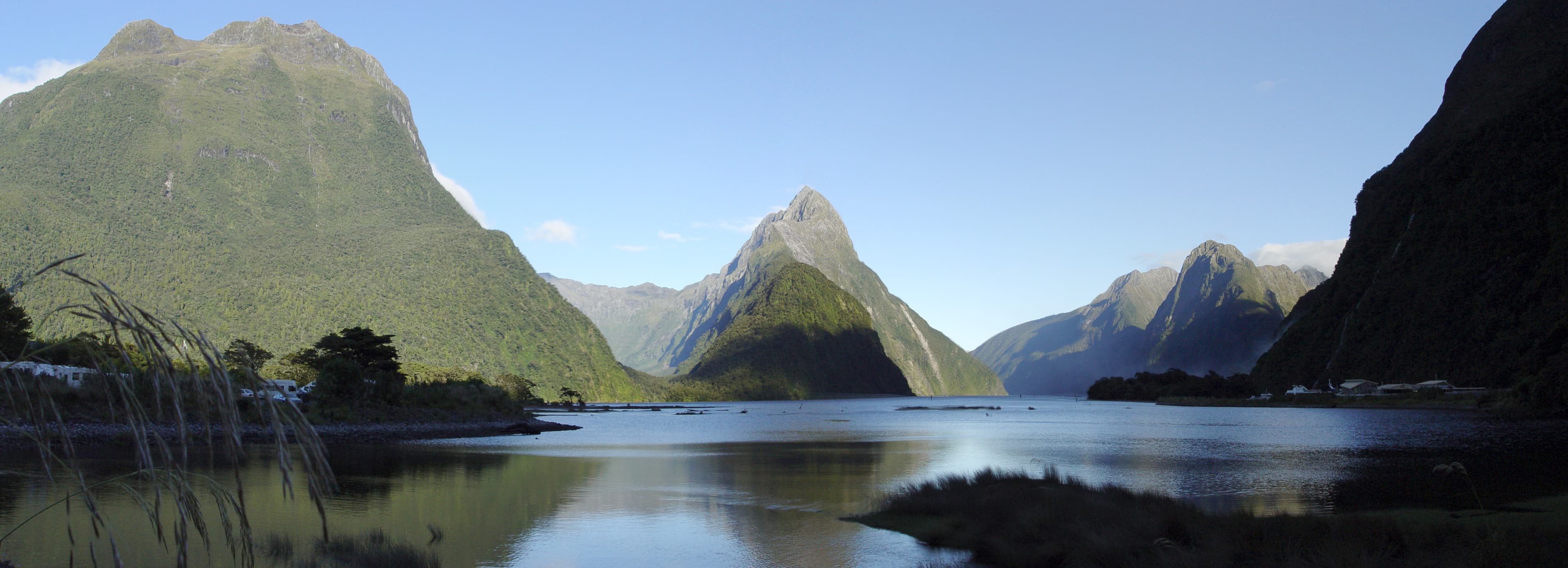
Milford Sound
Piopiotahi
Milford Sound — Natural landmark in Fiordland, southland.
Natural Landmark · Cliff in Southland
Photo: Wikimedia Commons (CC BY-SA)
 Written by Ben Cole· Updated Apr 2026
Find Nearby Accommodation
Hotels, apartments, hostels and luxury stays
We may earn a commission from bookings made through these links, at no extra cost to you.
About Milford Sound
Often called the eighth wonder of the world, Milford Sound is a fiord carved by glaciers over thousands of years. Mitre Peak rises 1,692m straight from the water, while permanent waterfalls like Stirling and Lady Bowen cascade from hanging valleys. Bottlenose dolphins, fur seals, and Fiordland crested penguins are regularly spotted.
Milford Sound — known to Māori as Piopiotahi — sits at the far end of State Highway 94 in Fiordland, about 120 kilometres northwest of Te Anau. It's New Zealand's most visited natural attraction, and the landscape makes it immediately clear why: sheer rock faces plunge straight into dark, still water, permanent waterfalls drop from hanging valleys above, and wildlife moves freely through the fiord with little apparent concern for visitors.
Technically a fiord rather than a sound (carved by glaciers rather than a river), Piopiotahi is one of the defining landforms of the South Island's southwest corner — a place where the scale of things takes some adjustment.
What to See and Do
The centrepiece of any visit is the fiord itself. Mitre Peak rises 1,692 metres directly from the water on the southern shoreline — one of the more striking vertical profiles you'll find anywhere in New Zealand. Two permanent waterfalls, Stirling Falls and Lady Bowen Falls, cascade year-round from the hanging valleys above, and after heavy rain the cliff faces run with dozens of temporary falls that transform the whole landscape.
Scenic cruises are the most popular way to experience the fiord, and for good reason — you get closer to the waterfalls, wildlife, and cliff faces than is possible from shore. A range of operators run half-day and full-day cruises from Milford Village, including overnight options. Book ahead, particularly between December and February when demand peaks.
Kayaking offers a quieter, closer alternative to the larger cruise vessels. Guided kayak tours operate within the fiord and give you a different relationship with the scale of the place.
Diving is also available, and the fiord's unusual conditions — a layer of dark tannin-stained freshwater sits above the salt water, filtering light — create an underwater environment where deep-water species can be found at surprisingly shallow depths.
Scenic flights over the fiord and surrounding Fiordland peaks are another option, particularly useful if you want a different perspective on the landscape or if poor road conditions make the drive in difficult.
Wildlife is reliably present. Bottlenose dolphins are frequently spotted in the fiord, fur seal colonies haul out on rocks near the entrance, and Fiordland crested penguins are occasionally seen, particularly in the colder months. Wildlife encounters are generally better from the water than from shore.
For those who prefer to stay on foot, walking tracks around Milford Village range from easy boardwalks to moderate day walks. The area is also the finishing point for the Milford Track, one of New Zealand's Great Walks.
History
Piopiotahi has been known to Māori for centuries. The name refers to the piopio, a bird now extinct, and the area held both practical and spiritual significance for Ngāi Tahu, the principal iwi of the South Island.
European awareness of the fiord developed in the 1820s, when explorer John Greylee first described it in writing. Despite its fame, the fiord remained genuinely difficult to access for a long time — the road through Homer Tunnel wasn't completed until 1954, meaning Milford Sound spent much of its early European history as a place people had heard of but relatively few had visited. The completion of the road transformed it into an accessible destination and, eventually, one of the country's most recognised landmarks.
Getting There and Access
Milford Sound is 120 kilometres from Te Anau via State Highway 94, a drive that takes roughly two hours. The road is widely considered one of the more scenic drives in New Zealand, passing through beech forest, alongside lakes, and through the single-lane Homer Tunnel before descending steeply into the fiord.
The road is winding with steep sections, and winter conditions can make it significantly more demanding — check road conditions before you travel between June and September. There is no public transport to Milford Sound, so you'll need to either self-drive or join an organised tour from Te Anau (around two hours) or Queenstown (four to five hours). Coach tours from both towns are widely available and typically include a cruise.
Parking at Milford Village is free, with capacity for around 500 vehicles. The car park fills during summer, particularly between 11am and 3pm. Arriving early in the morning or in the late afternoon improves your chances of securing a space. Accessible parking is available. If parking is a concern, travelling by coach tour removes it entirely.
Visitor Tips
- Book scenic cruises well in advance if visiting between December and February. Last-minute availability on peak days is limited.
- Sandflies are a serious inconvenience, not a minor one — bring effective insect repellent and wear it consistently, especially in calm weather when they're most active. Long sleeves help.
- Bring a waterproof jacket regardless of the forecast. Milford is one of the wettest places in New Zealand, and rain can arrive quickly. Notably, rain actually improves the experience by dramatically increasing the number of waterfalls.
- Food options at Milford Village are limited to a café. Bring your own supplies if you have dietary needs or want to keep costs down. Picnic areas with water access are available.
- Shade is limited throughout the site, which is worth keeping in mind on sunny days.
- If Milford is heavily crowded, a full-day cruise to Doubtful Sound — accessed via Te Anau — offers a comparable fiord experience in a quieter setting.
Best Time to Visit
Milford Sound is accessible and worth visiting year-round, and each season has its character. Summer (December to February) brings the most visitors and the best weather, but also the largest crowds and the most competitive parking. Shoulder months — March to May and October to November — offer a reasonable balance of good conditions and fewer people.
Winter visits are viable but require attention to road conditions and some acceptance of shorter days. Wetter periods, whenever they occur, dramatically increase the number of waterfalls visible across the cliff faces — if you arrive on a rainy day, this is not a bad thing.
Warnings
Getting There
From Te Anau (120 km, 2 hours via State Highway 94), one of New Zealand's most scenic drives. The road is winding with steep sections; check conditions in winter. No public transport available—self-drive or join a tour from Te Anau or Queenstown (4–5 hours).
Parking
Large free car park at Milford Village (capacity ~500 vehicles). Can fill quickly in summer (11am–3pm); arrive early or late afternoon. Accessible spaces available. Overflow parking limited; consider timing visits outside peak hours or booking a coach tour.
Visitor Tips
- •Book scenic cruises in advance, especially in peak season (December–February)
- •Wear waterproof jacket and insect repellent—sandflies are relentless, particularly in calm weather
- •Arrive early to secure parking and avoid afternoon crowds
- •Bring a camera with good zoom for wildlife—dolphins and seals are best spotted from the water
- •Consider a full-day cruise to Doubtful Sound as an alternative if Milford is crowded
Find Nearby Accommodation
Hotels, apartments, hostels and luxury stays
We may earn a commission from bookings made through these links, at no extra cost to you.
Quick Facts
At a Glance
Identity
- Traditional Name
- Piopiotahi
The Place
- Significance
- National
Plan Your Visit
- Entry
- Free
- Duration
- Half to full day
- Best Time
- Year-round, rainier months produce more waterfalls
Location
- Region
- Fiordland
- State
- Southland
Good to Know
Highlights
Activities
Family & Visitor Info
- Ages
- All ages. Scenic cruises suitable for infants; kayaking and diving require supervision for children. Walking tracks range from easy boardwalks to moderate day walks.
- Shade/Cover
- Limited shade
- Pram Friendly
- No
Food & Drink
Café at Milford Village; limited options so bring supplies. Picnic areas available with water access.
Features
Facilities
Nearby
Campsites(5)
Trails(3)
Attractions(1)
Find Nearby Accommodation
Hotels, apartments, hostels and luxury stays
We may earn a commission from bookings made through these links, at no extra cost to you.