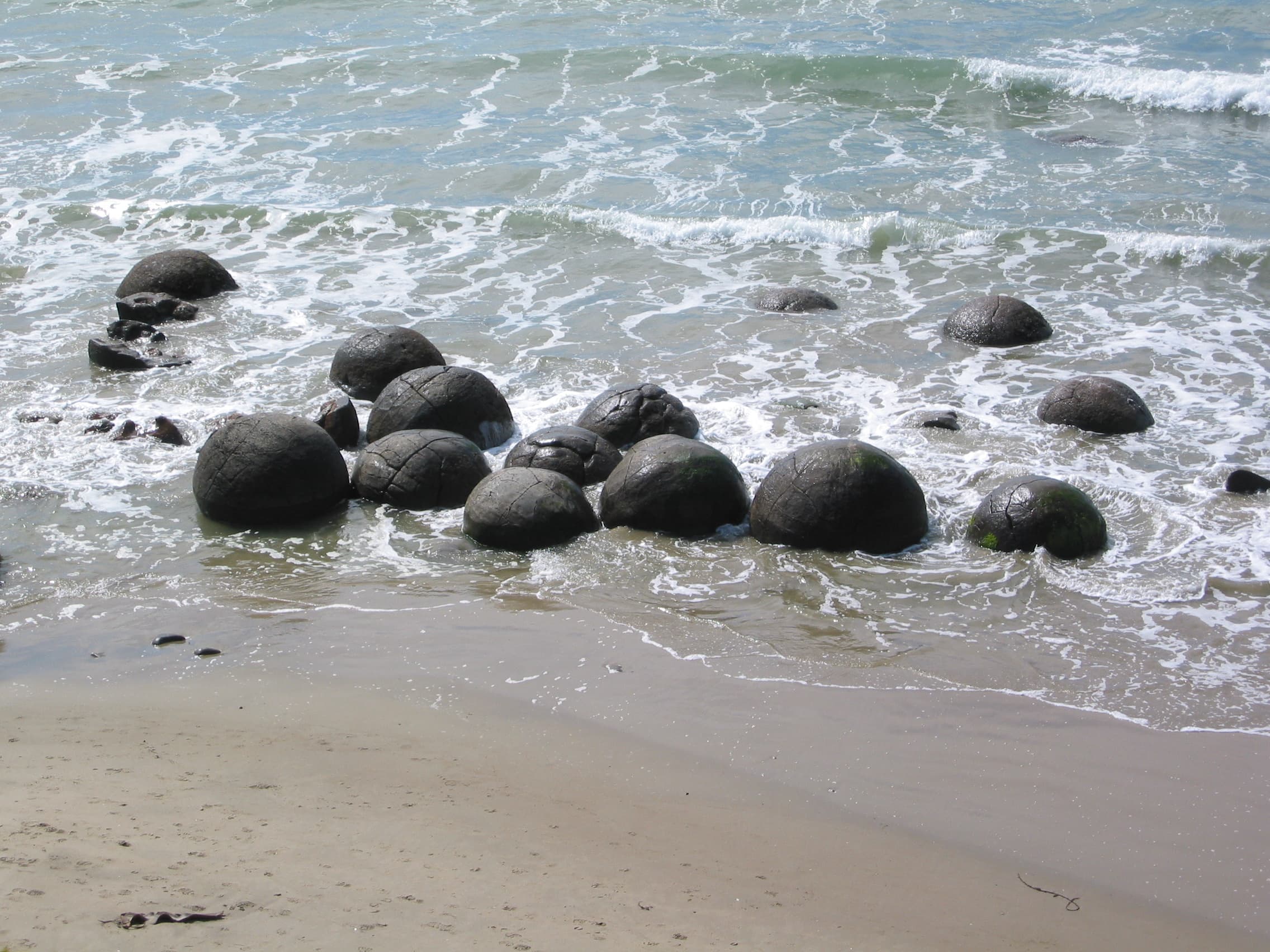
Moeraki Boulders
Moeraki Boulders — Natural landmark in Waitaki, otago.
Natural Landmark · Rock Formation in Otago
Photo: Wikimedia Commons (CC BY-SA)
 Written by Ben Cole· Updated Apr 2026
Find Nearby Accommodation
Hotels, apartments, hostels and luxury stays
We may earn a commission from bookings made through these links, at no extra cost to you.
About Moeraki Boulders
Unusually large and perfectly spherical boulders scattered along Koekohe Beach, some up to 2.2 metres in diameter and weighing several tonnes. Formed over 4 million years on the ancient sea floor by the accumulation of calcite around a core. Maori legend says they are calabashes and food baskets washed ashore from the wrecked canoe Araiteuru.
Koekohe Beach on the Otago coast is home to one of New Zealand's more peculiar natural sights: a collection of enormous, near-perfectly spherical boulders scattered across the sand and shallows. These are the Moeraki Boulders — some measuring up to 2.2 metres in diameter and weighing several tonnes — and they look, at first glance, as though they've been deliberately placed there by someone with an eye for sculpture. They haven't. What you're looking at is the result of a geological process that began on an ancient sea floor more than four million years ago.
The boulders sit along a stretch of beach between Oamaru and Dunedin, easily accessible from State Highway 1, and a visit fits comfortably into a 30-minute to one-hour stop — making them a natural break on the drive between the two towns.
History
The boulders formed through a process called concretion. Over millions of years, calcite gradually accumulated around small sediment cores on the sea floor, building up layer by layer into the spherical shapes you see today. As the coastline eroded over millennia, the surrounding mudstone cliffs broke down and the boulders were exposed, rolling out onto the beach where waves and tides have continued to wear some of them apart. You can see this clearly on the beach — some boulders are intact and whole, while others have cracked open to reveal their interior structure of radiating calcite crystals and septarian patterns.
For Māori, the boulders carry a different explanation. According to tradition, they are calabashes (gourds) and food baskets that washed ashore from the great canoe Araiteuru, which was wrecked during a voyage from Hawaiki. The canoe itself is said to be represented by a reef nearby. It's one of many Māori traditions connected to the natural features of the Otago coastline.
What to See and Do
The main draw is simply walking among the boulders themselves. At low tide, you can move freely between them across the sand and into the shallow water. Some sit in clusters, others stand alone, and the variety in their condition — from perfectly smooth and intact to cracked wide open — gives you a good sense of the geological forces at work over an enormous span of time.
The beach lends itself to beachcombing beyond the main boulder field, and the setting, with the dark cliffs behind and the Pacific in front, makes for rewarding photography. Sunrise is particularly well suited to this — the low-angle light catches the texture of the boulders and the wet sand in a way that midday sun doesn't.
Dogs are welcome on the beach, provided they're kept under control.
Getting There and Access
The Moeraki Boulders are on State Highway 1 in the Waitaki region, roughly 45 minutes south of Oamaru and 90 minutes north of Dunedin. Turn off at Moeraki village and follow the signs to the Koekohe Beach car park. There is no public transport to the site, so you'll need a vehicle.
The free car park holds around 40–50 vehicles and includes accessible parking spaces. It's generally sufficient outside of the peak summer holiday period (December–January), when it can fill up. If the car park is full, there's overflow parking in Moeraki village, about five minutes' walk away.
Entry to the beach is free.
Visitor Tips
- Footwear matters. The boulder field is rocky underfoot, so water shoes or sandals with some grip are more comfortable than bare feet or jandals.
- Check the tides. The boulders are more accessible at lower tides, when you can walk around and between them without wading. A quick search for Moeraki tide times before you leave will help you plan.
- Arrive early for photography. The 6–7am window in summer gives you soft sunrise light and far fewer people. In the middle of the day during peak season, the site can get busy.
- Shade is limited. There's little shelter on the beach, so bring sunscreen and a hat if you're visiting in summer.
- Combine with the village. Moeraki village is five minutes away and has fish and chips and café options — a good spot to stop before or after your visit.
Best Time to Visit
December to February offers the warmest weather and the longest daylight hours. Summer sunrise, around 6–7am, is the ideal time for photography and quiet beach access. Weekday mornings are quieter than weekends.
Winter visits (June–August) are possible but rough surf and storms can make the beach less pleasant and access to the boulders more difficult. Autumn and spring offer a reasonable middle ground — cooler temperatures but generally calmer conditions than the depths of winter.
Facilities
There's a café at the car park for coffee and a light bite, along with toilets and picnic tables near the parking area. You're welcome to bring your own food. For a more substantial meal, Moeraki village nearby is the better option.
Getting There
On State Highway 1 between Oamaru (45 mins north) and Dunedin (90 mins south). Turn off at Moeraki village and follow signs to Koekohe Beach car park. About 20 mins south of Oamaru, 15 mins north of Hampden. No public transport available.
Parking
Free car park at Koekohe Beach with approximately 40-50 spaces. Generally adequate except during peak summer holidays (Dec-Jan). Accessible parking available. Overflow parking in Moeraki village (5 mins walk away).
Visitor Tips
- •Arrive early (6-7am) for sunrise photography when light hits the boulders beautifully and crowds are minimal
- •Bring water shoes or sandals — the boulder field is rocky underfoot
- •Check tide times before visiting; boulders are more accessible at lower tides
- •Dogs are welcome but keep them under control on the beach
- •Combine with nearby Moeraki village (5 mins) for fish and chips or coffee
Find Nearby Accommodation
Hotels, apartments, hostels and luxury stays
We may earn a commission from bookings made through these links, at no extra cost to you.
Quick Facts
At a Glance
The Place
- Significance
- Regional
Plan Your Visit
- Entry
- Free
- Duration
- 30 minutes - 1 hour
- Best Time
- December to February for warmest weather and longest daylight. Sunrise in summer (around 6-7am) is ideal for photography. Avoid winter storms (June-August) when surf is rough. Any day of the week works; quieter on weekday mornings.
Location
- Region
- Waitaki
- State
- Otago
Good to Know
Highlights
Activities
Family & Visitor Info
- Ages
- All ages
- Shade/Cover
- Limited shade
- Pram Friendly
- No
Food & Drink
Café at the beach car park. Better food options in Moeraki village including fish and chips and cafés. Picnic tables near parking area.
Features
Facilities
Nearby
Campsites(5)
Trails(3)
Attractions(1)
Find Nearby Accommodation
Hotels, apartments, hostels and luxury stays
We may earn a commission from bookings made through these links, at no extra cost to you.